
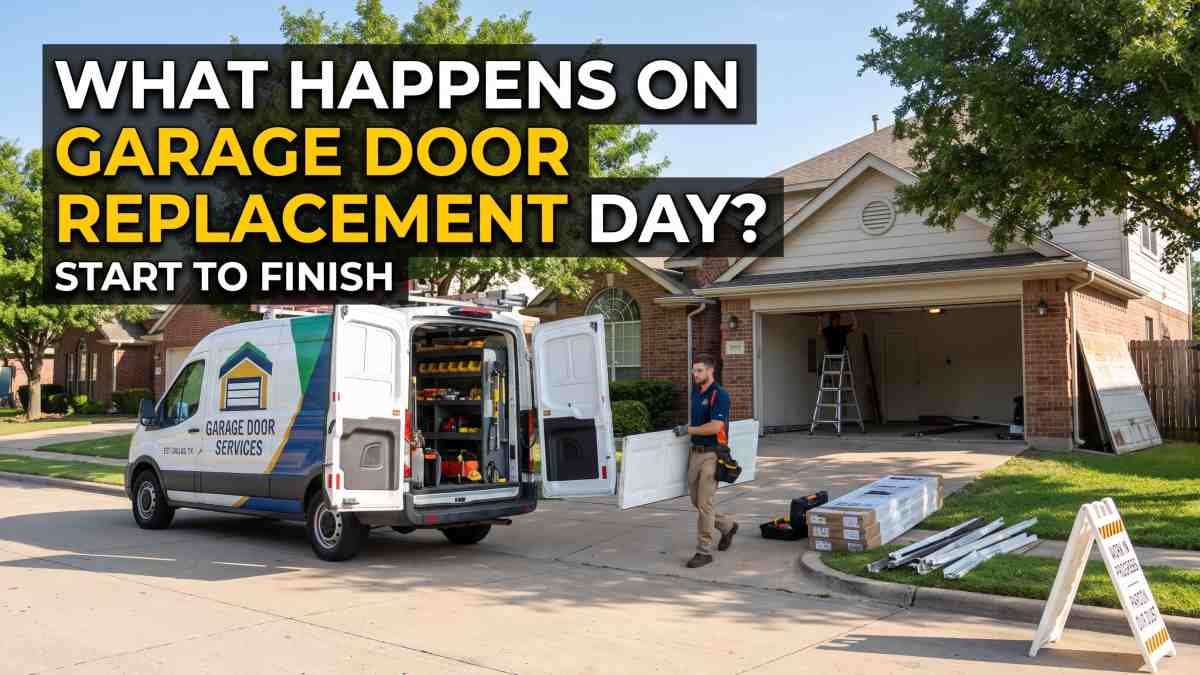
In short: Garage door replacement day is mostly the crew’s work, and your job is staying clear of it. Clear the garage, keep children and pets away, and test the new door before anyone leaves. That’s what happens on garage door replacement day, and why the open doorway is the part to respect.
In Short: The Open Doorway Is the Danger Zone
During replacement, the old door comes down and the new one goes up, which leaves an open doorway and springs under tension. DASMA says installing a garage door can be very dangerous and recommends trained door systems technicians. So the safest homeowner plan is simple: prepare the space, then stay out of the work zone.
That’s why this guide puts safety first. Each prep step has a reason, and each test at the end comes from a named source. Springs, lift cables and bottom brackets are professional-only, so you won’t find DIY steps here.
Before the Crew Arrives: Prep That Keeps Everyone Clear
What happens on garage door replacement day starts the evening before, with a clear garage and a plan for who’s home. Clopay reports asking homeowners to clear the garage at least 10 feet back from the opening and park cars elsewhere for a few hours. Each step keeps people and belongings out of the path of heavy door sections.
What to move out of the way
Move cars, bikes, trash cans and anything stored near the door opening or the track. Leave the area around the opener clear too, and make sure the crew can reach an outlet. A1 Garage reports asking for safe access to an outlet for the opener.
Who should be home, and what about security
Clopay’s installation page asks for an adult 18 or older to be present and able to sign paperwork. The same page says you’ll inspect the finished door with the installer and sign a customer acceptance form. Other companies may set different rules, so ask yours.
While the old door is out, the opening is exposed. Ask whether the crew will secure it if they leave for parts, and keep the house door from the garage locked.
Kids and pets: why they stay away
Keep children and pets indoors until the crew is done. The doorway is open, the door sections are heavy, and DASMA warns about the high tension in spring systems. A curious child near that work is a risk you can remove completely.
Your 7-item prep checklist
- Clear 10 feet back from the opening. Clopay reports asking for it, and it gives the crew room to work.
- Park both cars outside. Clopay says for a few hours, which keeps vehicles out of harm’s way.
- Move items off walls and shelves near the track. Loose items can fall when long parts are carried past.
- Confirm an adult will be home. Someone has to inspect the door and sign.
- Keep children and pets indoors. The doorway is open and the springs are under tension.
- Unlock and clear a path to an outlet and the house door. The opener needs power to be connected and tested.
- Keep your written quote handy. You’ll compare what’s installed with what’s listed.
How Long Replacement Day Takes (and Why the Numbers Disagree)
How long garage door replacement takes depends on the door and what else needs work, so sources disagree. A1 Garage reports four to six hours as the standard answer, Richards-Wilcox says it may take four to six hours, and Clopay says installation is done in a day. Ask your company for its own window before the appointment.
| Source | What it reports | What it measures |
|---|---|---|
| A1 Garage (installer) | “Standard answer is 4–6 hours”; most projects half a day to a full day | Time on site |
| Richards-Wilcox, via CADdetails | Average installation “may take four to six hours” | Time on site |
| Clopay blog (manufacturer) | Installation “is done in a day” | Time on site |
| Clopay “What to Expect” page | Most doors installed within 2–4 weeks | Wait after ordering, not time on site |
Note: These are figures reported by the companies named, not Dallas-specific or guaranteed. Door size, spring and track work, and the condition of the opening change the time.
Don’t confuse lead time with install time. The 2–4 weeks Clopay reports is the wait for the door to arrive, not the time the crew spends at your house.
What the Crew Does, in the Order You’ll See It
Expect a sequence like this, though each company sets its own order.
Arrival and work-area setup
The crew arrives, checks the opening and confirms the plan against your written quote. Ask them to walk you through it before they start. That’s the moment to mention anything you’ve noticed about the frame.
Old door out: why springs are the crew’s job only
The old door comes out first. You’ll hear metal and see sections lifted away, but watch from a distance, not through the open doorway.
Do not touch: springs, lift cables and bottom brackets
These parts carry the door’s weight under high tension, and DASMA says only trained professionals should handle them. A slip can cause serious injury, so stay out of the doorway while the door is open.
New door in: track, sections and hardware
Next the crew sets the new track, builds the door section by section, and attaches the hinges, rollers, lift cables and springs. Clopay reports that its installers use new track, springs and hardware rather than reusing the old ones. Expect the door to take shape gradually, not all at once.
Where the opener fits in
Then the crew connects the opener to the new door. Clopay reports that an existing opener should work with a new door if it’s in good condition. DASMA’s checklist says an opener should be replaced if its entrapment protection features are missing, so ask the technician to confirm yours has them.
If your opener is wired into an alarm or logs entry and exit, tell the company. Texas DPS says a license applies to that kind of connection. For what drives an opener’s price, see what makes an opener replacement cost more or less.
What Gets Hauled Away, and What Shouldn’t Be Reused
Ask whether removal and haul-away are included. Clopay reports that its installers remove and haul away the old door and track, and that old track, springs and hardware are not reused. A1 Garage says reusing old tracks is unsafe and can void warranties.
Put removal, haul-away and any reused parts in writing before the appointment. Richards-Wilcox lists cleanup and removal of the old door as part of the visit, so ask how your company handles leftover debris.
When the Opening Isn’t Ready: Damaged Frame, Headroom or Fit Problems
Sometimes the opening needs work before the new door can go in. Clopay’s inspection steps list possible extras, such as replacing jambs when framing is rotted, damaged or not up to code, and installing a low headroom kit. Its page also warns that extra work can bring additional charges.
If the crew finds damaged track, a damaged frame or a door that doesn’t fit, stop and ask for a written change order before work continues. It should say what’s wrong, what the fix is and what it adds to the quote. Ask the crew to photograph the problem, and ask how they’ll secure the opening while you decide.
Take a moment before approving more work. If you’re not sure what a problem means, talk it through first.
.Not sure what is wrong? Call, describe the problem, and ask for a written quote before work starts.
Dallas Garage Door Fix is a homeowner resource that connects you with a participating local garage door company. We don’t perform the repairs ourselves, and we may receive a referral fee from participating companies. Response times and prices are set by the company that takes your call.
Before the Crew Leaves: The Handoff Tests
Before the crew leaves, run the handoff tests together: the auto-reverse test with a 2×4, the photo-eye height, and the release handle and wall button placement. Each takes a few minutes and shows whether the door and opener were set up safely. Ask the technician to run them while you watch.
DASMA says the safety reversal system must always be tested using a 2×4 laid flat on the ground, and that paper towels are not an acceptable substitute. Its explainer, Paper Towels vs. 2x4s, shows why the test height matters.
| Test | What you should see | If it fails |
|---|---|---|
| Auto-reverse with a flat 2×4 | The door touches the 2×4, reverses and returns fully open | Ask the technician to adjust and retest |
| Photo-eye beam height | Beam no higher than six inches above the floor (DASMA checklist) | Ask for it to be lowered |
| Photo-eye reversal | Wave an object through the beam as the door closes, and the door reverses and opens fully | Ask for the sensor to be realigned |
| Release handle | Red, easy to reach and no more than six feet above the floor (DASMA checklist); the technician shows you how it works | Ask for it to be moved or replaced |
| Wall button | At least five feet above adjacent walking surfaces (DASMA checklist) | Ask for it to be remounted |
| Door balance | The technician lifts the door partway and it stays put | Ask for the springs to be rechecked |
| Remotes and keypad | Each one you’ll use opens and closes the door | Ask for it to be reprogrammed |
Note: These tests come from DASMA’s checklist for sectional door operators and its 2×4 guidance, and your opener manual may list more. Stand clear of the door while it runs, never under it.
Sign the customer acceptance form only after the door passes. Clopay reports that its process includes inspecting the installed door with the installer and signing that form.
What to Leave With: Paperwork, Warranty Terms, Final Payment
Leave with the written warranty terms, an itemized final invoice and the instructions for the door and opener. The Texas Attorney General advises getting the terms of any warranty in writing and keeping a copy of all documents. Lone Star Legal Aid advises holding the final payment until you’ve inspected the work and are satisfied.
- Warranty terms. They tell you what’s covered if something fails.
- Itemized invoice. It lets you match parts and labor to your written quote.
- Instructions for the door and opener. They list the manufacturer’s safety steps for your model.
- A copy of the acceptance form. It shows what you signed and when.
If you’re still choosing who to hire, see how to choose a garage door company in Dallas for the questions to ask before you book.
The First Weeks With a New Door
A new door still needs regular checks, and the safety tests don’t end at handoff.
The U.S. Consumer Product Safety Commission advises inspecting the garage door and opener every 30 days and testing the automatic reverse with a 2×4. Its guide, Non-Reversing Automatic Garage Door Openers Are a Hazard, also recommends keeping remotes away from children.
If the new door starts reversing on its own or won’t close, call the company that installed it first, since the work and the warranty are theirs. Our page on sensor repair explains the signs when the photo-eye sensors are the cause.
Door stuck right now? Call, describe the problem, and ask for a written quote before work starts.
Dallas Garage Door Fix is a homeowner resource that connects you with a participating local garage door company. We don’t perform the repairs ourselves, and we may receive a referral fee from participating companies. Response times and prices are set by the company that takes your call.
Frequently Asked Questions
Clopay reports that its installers remove and haul away the old door and track. Other companies may handle it differently, so ask before you book. Put removal and haul-away in the written quote.
Not always. Clopay reports that your current opener should work with the new door if it’s in good condition. DASMA’s checklist adds that an opener should be replaced if its entrapment protection features are missing, so ask the technician to confirm.
Clopay reports that old track, springs and hardware are not reused with a new door. Cables and rollers count as hardware. Check your written quote to see which parts are new.
Clopay asks for an adult 18 or older to be present and able to sign paperwork. You also need to be available to inspect the finished door with the installer. If you can’t be there, ask the company who else can sign for you.
Yes. Clopay reports asking homeowners to clear the garage at least 10 feet back from the opening and park cars elsewhere for a few hours. Clearing the space protects your belongings and keeps the work area safe.
Reported figures run from four to six hours to a full day, but they vary by door and by what else needs work. Your garage is unusable while the door is out and until the new one passes testing. Ask your company for its window, and have another place for your car.
Stop and ask for a written change order before more work happens. Clopay’s inspection steps list extras such as replacing jambs and installing a low headroom kit, which can bring additional charges. Ask how the crew will secure the opening while you decide.
Ask the technician to run the auto-reverse test with a flat 2×4, check that the photo-eye beam is no higher than six inches from the floor, and show you the release handle. DASMA says the 2×4 is the required test. Stand clear of the door while it runs.
DASMA says installing a garage door can be very dangerous and isn’t recommended for a novice. It recommends trained door systems technicians. Springs, cables and bottom brackets carry high tension, so this isn’t a weekend project.
Get the written warranty terms, an itemized final invoice and the door and opener instructions. The Texas Attorney General advises getting warranty terms in writing and keeping a copy of all documents. Keep the signed acceptance form with them.
That covers what happens on garage door replacement day, from the first clearing of the garage to the final test. For plain-language help with specific problems, start at the Dallas Garage Door Fix homepage.
Ready to talk to someone? Call, describe the problem, and ask for a written quote before work starts.
Dallas Garage Door Fix is a homeowner resource that connects you with a participating local garage door company. We don’t perform the repairs ourselves, and we may receive a referral fee from participating companies. Response times and prices are set by the company that takes your call.