

In short: Texas heat makes the garage door worth a second look, and a high R-value on the sticker doesn’t settle it. DASMA says the number to compare is U-factor, tested on the whole door. This guide explains garage door insulation and R-value for Texas heat, plus what to ask before you buy.
In Short: Texas Heat Makes the Door Matter, but R-Value Isn’t the Whole Story
An insulated garage door slows heat moving through the door, which matters in North Texas summers. R-value rates that resistance for a single door section, while DASMA says U-factor, tested on the whole door, is the better number to compare. Ask for both, and don’t judge a door by R-value alone.
We couldn’t find a neutral source that measures how much cooler a Dallas garage gets with an insulated door, so this guide doesn’t invent a number. It gives you verified definitions, the right number to compare and a checklist for your next quote. The sections follow the order of a real purchase: the heat, the numbers, the seals, how you use the garage, retrofits and the questions to ask.
What North Texas Heat Looks Like on Paper
North Texas summer heat is well documented. The National Weather Service’s DFW records show a high of 71 days at 100 degrees or above in a single year (2011) and a run of 42 in a row from June 23 to August 3, 1980. See its DFW 100-degree day records for the full table.
The same office lists the average first 100-degree day at DFW as July 1 and the average last as August 27. Garage door insulation for North Texas summers is really a question about that stretch of the calendar. The useful question isn’t how hot it gets, but how much heat the door lets through and how tightly it seals.
Those figures describe air temperature, not what happens inside your garage or on the surface of your door. No neutral source we found measures garage temperatures in Dallas, so be cautious of any page that quotes one without naming where it came from.
R-Value in Plain Language (and What It Can’t Tell You)
R-value measures thermal resistance, and a higher number means better insulation. DASMA says it’s based on the material and its thickness. It describes a door section, not the whole installed door, so treat it as one clue and not the full answer.
Garaga, a door manufacturer, reports that an attached garage needs at least R-10, a heated garage at least R-12, and a workshop or home gym at least R-16. Those ranges are by use, not by Texas climate, and they come from a manufacturer, so treat them as a starting point.
The core material matters too. Garaga reports that polystyrene performs about half as well as polyurethane at the same thickness. Retrofit kits usually use foam board or reflective foil, which the retrofit section below covers.
DASMA explains that the R-value in a door’s literature is calculated by adding up the resistance of the air films, the inside and outside surfaces and the insulation in one section. That method ignores joints and stile attachments, which are part of how a real door performs.
U-Factor: The Number DASMA Says to Compare
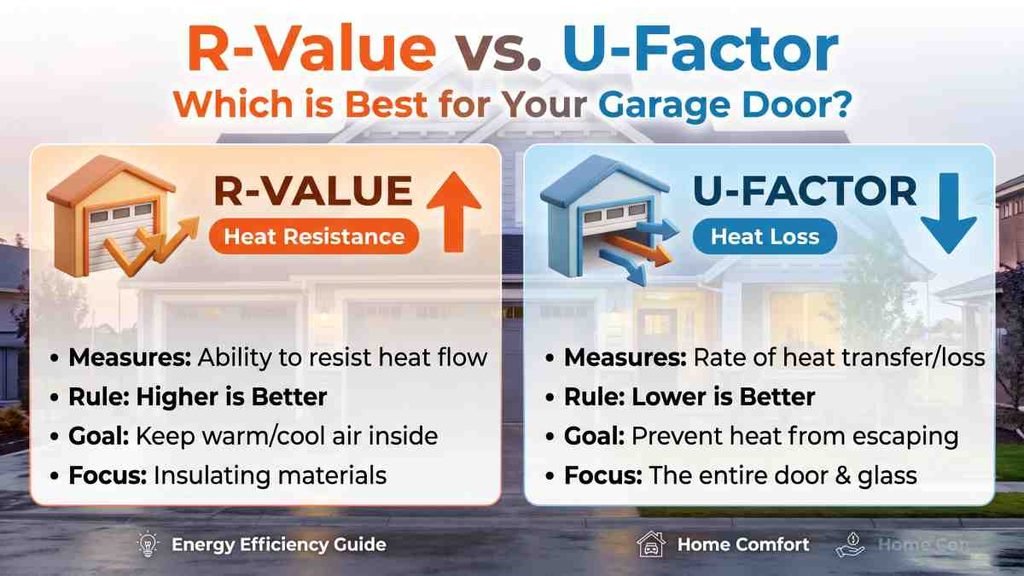
U-factor measures how much heat passes through a garage door, so a lower number means better insulation. DASMA tests it on the complete installed door under ANSI/DASMA 105, including sections, track and hardware. That’s why DASMA treats it as the number to compare.
DASMA’s Technical Data Sheet 163 adds that U-factor and R-value are not reciprocals of each other and can’t be compared directly.
The same sheet says the calculated R-value method should not be used for garage door assemblies, and that building codes and standards address garage doors in terms of U-factor. DASMA also runs a Thermal Performance Verification Program with ICC-ES that lists verified doors with no more than 16% window area.
This matters at quote time. If one company quotes an R-value and another quotes a tested U-factor, you’re comparing two different things, so ask the first for the U-factor and the second for the section’s R-value. Neither number alone is a verdict.
| R-value | U-factor | |
|---|---|---|
| What it rates | One door section, by calculation | The complete installed door, by lab test |
| Better when it is | Higher | Lower |
| What it leaves out | Joints and stile attachments | DASMA’s verification program doesn’t cover air leakage or solar heat gain |
Note: Definitions and limits come from DASMA Technical Data Sheets 163 and 196, and neither sheet sets a recommended U-factor for Texas.
DASMA explains that a door’s R-value is only a calculation through the center of one door section, while U-factor is tested on the whole door under ANSI/DASMA 105. Its sheet on U-factor and the DASMA Thermal Performance Verification Program is a good reference to bring to a quote.
Why Seals and Joints Count as Much as Foam
Garaga says R-value alone isn’t enough, because weatherstripping between sections, the bottom seal, perimeter weatherstripping and section joints all affect how a door performs. DASMA describes a thermally efficient door as one with an insulated core and a meeting rail with a thermal break.
A gap at the bottom or sides lets outside air in no matter what’s inside the panels. If a seal has cracked or torn, ask the company about replacing it.
Garaga suggests checking whether the bottom weatherstripping needs to be changed and whether the perimeter seal has started to crack and tear. Both are things you can see from the garage floor, without touching the door.
Which Door Does Your Garage Need?
It depends on how you use the garage, and the ranges below are reported by Garaga, not set by a Texas rule.
Attached garage
Garaga reports at least R-10 for an attached garage. If living space sits next to or above the garage, ask the company how the door’s rating compares with the wall it sits in. Garaga adds that garage ceilings and exterior walls need different R-values because warm air rises, so the door is only one part of the picture.
Workshop or home gym
Garaga reports at least R-16 for these uses, because people spend hours in them. If you’ll be working in the space, ask for a tested U-factor rather than relying on R-value alone.
Detached storage
Garaga says a lightly insulated or non-insulated door may be enough for a detached, unheated garage. If you only park and store things, ask the company what a lighter option would look like.
Whichever use fits, the same rule applies: ask for the U-factor, get the rating in writing and ask for a written quote that lists parts and labor before work starts.
Adding Insulation to an Existing Door: What to Know First
Adding insulation to an existing door is possible, but the added weight can change how the door balances. Affordable Door Co reports it can throw off the springs and strain the opener, and DASMA says springs are professional-only. Have a technician check the balance before and after.
Affordable Door Co, an Oklahoma City door company, reports that foam board kits are the most popular retrofit and that reflective foil is a lighter option. It also reports that added weight can wear springs faster.
DASMA says awkward operation by hand may mean a spring system that is out of balance, and its checklist says proper operation of the door, opener and entrapment protection depends on a balanced door. Affordable Door Co advises having a technician check spring tension before adding insulation.
Do not touch: springs, lift cables and bottom brackets
These parts carry the door’s weight under high tension, and DASMA says only trained professionals should handle them. Never adjust them to compensate for added insulation, because a slip can cause serious injury.
If the door suddenly feels heavy or hard to move after a retrofit, stop using it and call a professional. Our page on spring repair explains what a technician checks.
Not sure what is wrong? Call, describe the problem, and ask for a written quote before work starts.
Dallas Garage Door Fix is a homeowner resource that connects you with a participating local garage door company. We don’t perform the repairs ourselves, and we may receive a referral fee from participating companies. Response times and prices are set by the company that takes your call.
Replace the Door or Retrofit? Questions That Decide It
No neutral source we found says one option beats the other for every Dallas garage, so the answer depends on your door. Four questions settle most of it.
- Is the door sound apart from the missing insulation? A retrofit adds weight to a door that still has to balance.
- Do you want a tested rating? A new door can come with a U-factor tested under ANSI/DASMA 105, while a retrofit changes a door after it was rated, so ask whether the original rating still applies.
- What will each option change? Ask the company to list the parts, the labor and any spring or opener work.
- Do you have the quote in writing? A written quote that lists parts and labor makes the options comparable.
If your door is old, dented or already hard to balance, adding weight is a poor starting point, and a technician can tell you whether it’s a candidate. If you replace the door, see what happens on garage door replacement day for how the day goes.
What to Ask the Company Before You Buy or Retrofit
Bring this checklist to any quote for garage door insulation and R-value for Texas heat.
- What’s the U-factor, and was it tested under ANSI/DASMA 105? It’s the number DASMA says to compare.
- Is the door in DASMA’s Thermal Performance Verification Program? It’s a verified listing, though it covers only doors with no more than 16% window area.
- What’s the R-value, and does it describe a section or the whole door? R-value covers only a section.
- Is the core polyurethane or polystyrene, and how thick is it? Garaga reports a large performance gap between them.
- Which seals are included? Gaps let outside air in whatever the core is.
- For a retrofit, who will check the balance afterward? Added weight can throw off the springs, and balance work is professional-only.
- Is everything on a written quote with parts and labor? Our guide on how to choose a garage door company in Dallas covers what that quote should include.
Keep the answers with your written quote. If two companies give you different numbers, ask each to show the test or listing behind them, since a verified rating can be documented and a sales claim often can’t.
If a door has already stuck or feels unsafe, don’t wait for a better quote.
Door stuck right now? Call, describe the problem, and ask for a written quote before work starts.
Dallas Garage Door Fix is a homeowner resource that connects you with a participating local garage door company. We don’t perform the repairs ourselves, and we may receive a referral fee from participating companies. Response times and prices are set by the company that takes your call.
Frequently Asked Questions
It matters as one clue, not the whole answer. R-value rates the thermal resistance of a door section, based on material and thickness, and higher is better. DASMA says U-factor, tested on the whole door, is the better number for comparing doors, so ask for both.
We didn’t find a neutral Texas-specific figure, so we won’t invent one. Garaga, a manufacturer, reports at least R-10 for an attached garage, R-12 for a heated one and R-16 for a workshop or home gym. Treat those as a starting point and ask for a tested U-factor.
R-value measures the thermal resistance of a door section, and higher is better. U-factor measures heat passing through the whole tested door, and lower is better. DASMA says the two aren’t reciprocals and can’t be compared directly.
An insulated door slows heat moving through the door, but we found no neutral source that measures how much cooler a Dallas garage gets. Seals and gaps matter too, since Garaga says weatherstripping affects performance. DASMA’s verification program doesn’t cover air leakage or solar heat gain.
Garaga reports that polystyrene performs about half as well as polyurethane at the same thickness. That comes from a manufacturer, so compare the finished door’s tested U-factor rather than the core material alone. Ask the company which core the door uses and how thick it is.
Retrofit kits exist, and Affordable Door Co reports foam board and reflective foil as common types. The added weight can change how the door balances, so have a technician check it afterward. Don’t adjust the springs yourself.
It can. Affordable Door Co reports that added weight can throw off spring balance, strain the opener and wear springs faster. DASMA says a door’s operation depends on balance and that springs are professional-only, so stop and call a technician if the door feels heavier afterward.
Garaga says R-value alone isn’t enough, and that weatherstripping between sections, the bottom seal and perimeter seals matter too. A gap lets outside air in regardless of what’s inside the panels. Ask which seals come with a door and whether worn ones should be replaced.
We found no neutral, Dallas-specific figure for savings, so we won’t quote one. The effect depends on how much you use the garage, how it connects to your living space and how well the door is sealed. Ask any company to explain a savings claim in writing.
Kits exist, but the risk is in the balance, not the foam. Affordable Door Co reports that the added weight can throw off the springs, and DASMA says springs, cables and bottom brackets are professional-only. Have a technician check the balance before and after.
That covers garage door insulation and R-value for Texas heat, from the heat records to the questions for your next quote. For plain-language help with specific problems, start at the Dallas Garage Door Fix homepage.
Ready to talk to someone? Call, describe the problem, and ask for a written quote before work starts.
Dallas Garage Door Fix is a homeowner resource that connects you with a participating local garage door company. We don’t perform the repairs ourselves, and we may receive a referral fee from participating companies. Response times and prices are set by the company that takes your call.