
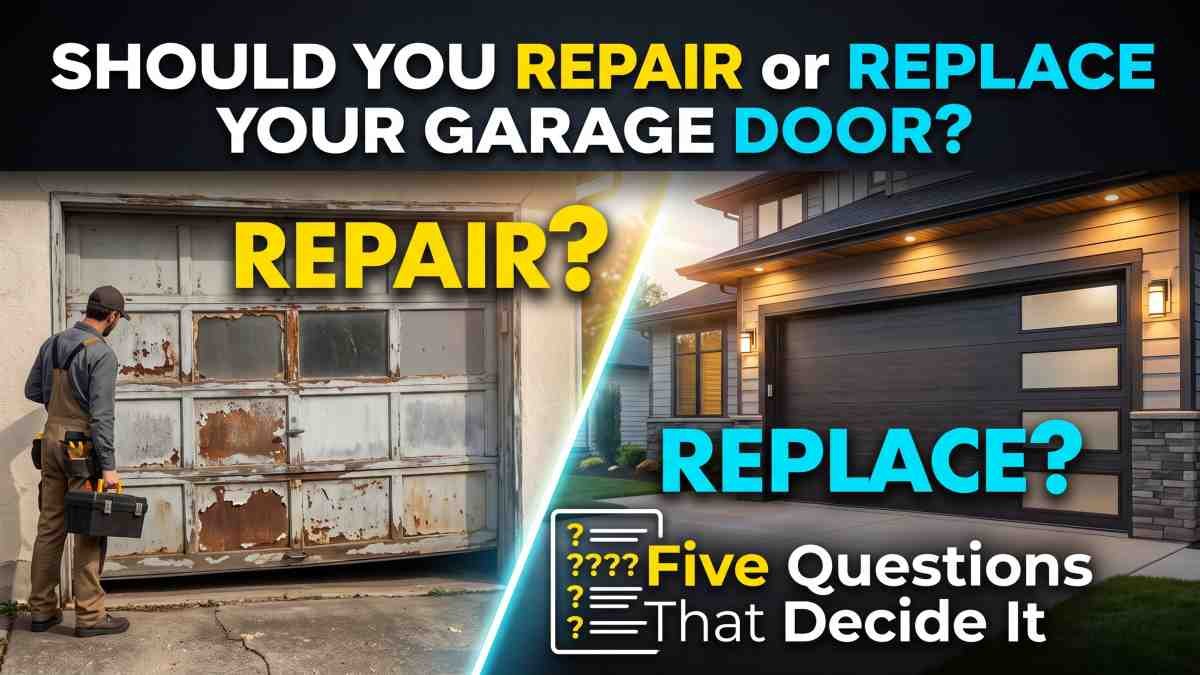
A garage door that sags, grinds, or stops halfway up raises an expensive question. Most Dallas homeowners can’t tell whether they’re looking at one worn part or a door at the end of its life. The answer depends less on the door’s age than on which part is actually failing. This guide walks through the repair or replace garage door decision in the order a technician would think about it: the door, then the lift hardware, then the opener.
In short: it depends on which part is failing
Those three parts fail on different schedules. A dented section tells you nothing about the opener, and a worn opener tells you nothing about the springs.
A door that “mostly works” can still be unsafe. A door that drifts, jerks, or reverses on its own is telling you something, so don’t wait for it to stop completely before you look into it.
Name the failing part first
Start by naming the part that failed, because each one has its own answer. A door section can often be repaired or swapped alone. Springs, cables and tracks are serviced by a professional, and springs are replaced as a set. An opener can be replaced without touching the door.
A damaged door section

A sectional door is a stack of panels joined by hinges and rolled on a track. When one section is dented or cracked, the question is whether the rest of the door is sound.
You can replace one garage door panel in many cases, which is often cheaper than replacing the whole door. Whether it makes sense depends on the other sections and the hardware. If only one section is damaged and the door still travels evenly, replacing a single door section is usually the first thing to price. If several sections are damaged, the math changes. Ask the company to quote both.
Springs, cables and tracks
Most modern sectional doors use torsion springs mounted above the door. Many older doors use extension springs that run along the sides. In both cases the springs do the lifting, not the opener.
That’s why a broken spring is often mistaken for a failed opener. The motor hums, but the door stays down, because a broken torsion spring can no longer counterbalance the door’s weight. If you hear a loud bang and the door won’t lift, think spring before you think opener.
The Door & Access Systems Manufacturers Association (DASMA) says: “If your door has two springs, replace both, even if one is not broken.” That makes spring repair a pair-replacement job, and you should leave it to a technician. Lift cables and bottom brackets carry the same tension risk. Tracks are different: they bend from impact, and a technician has to inspect them before anyone decides whether they can be straightened or need replacing.
The opener
The opener is a separate system. Chain, belt and screw-drive units all slide a trolley along a drive rail to move the door. If the door itself moves smoothly by hand, the problem may be the opener alone.
An opener can be replaced without replacing the door, and a door can be replaced while the existing opener stays. Check opener repair first when the opener has a clear, limited fault, such as a failed logic board or a remote that won’t pair. Replacement becomes the better question when the opener is old or lacks modern safety features (more on that below).
Five questions that settle repair vs. replace
The repair or replace garage door question gets easier once you answer five things. Each one comes with a plain reading of what your answer means. Run through them before you call anyone.
How many parts are failing at once?
One failed part is a repair. Three or four worn parts, such as a damaged section, tired rollers, a frayed cable and a struggling opener, make replacement worth pricing.
What it means: You’ll see the repair total climb with each added item. No honest rule of thumb exists here, so ask for a repair quote and a replacement quote side by side.
Is the damage cosmetic or structural?
Can a dented garage door be fixed? Often yes, if the dent is shallow and the door still opens and closes evenly. A dent that stays on the surface is cosmetic.
Structural damage is different. A creased or cracked section, a bent frame, or a door that no longer travels evenly in the track points to structural damage.
What it means: Cosmetic damage rarely forces replacement. Structural damage usually does, because the section can no longer carry the door’s weight evenly.
Was the door hit by a car or a storm?
Can a garage door be repaired after being hit by a car? Sometimes, but the visible dent is rarely the whole story. Impact can bend the track, knock the door off its rollers, and stress hinges you can’t see from the floor.
If the door is crooked, jammed, or hanging off the track, stop using it until a technician has looked at it.
What it means: The more hardware the impact touched, the more likely the answer is replacement.
Do the safety features still work?
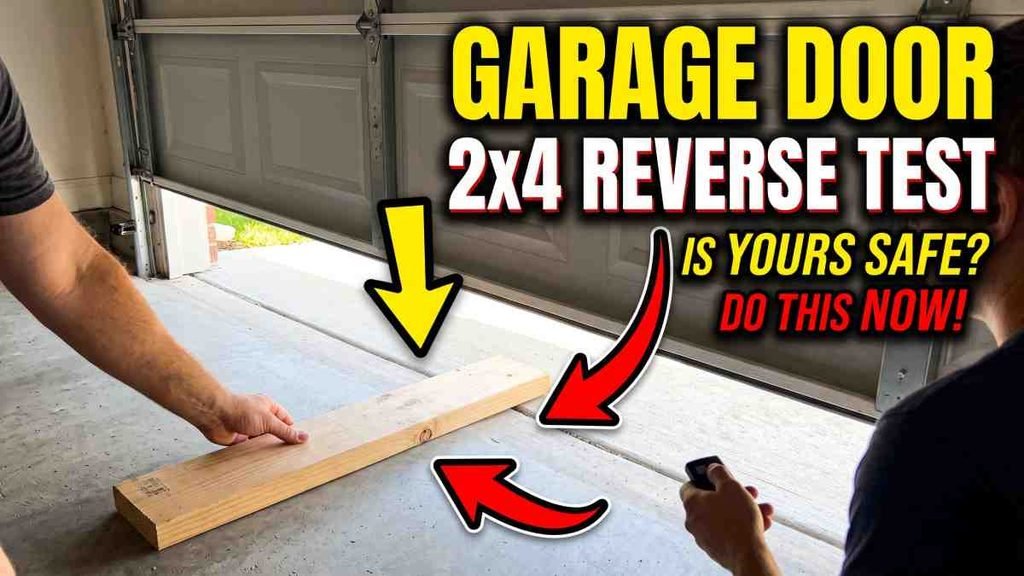
The U.S. Consumer Product Safety Commission (CPSC) tells homeowners to inspect the garage door and opener every 30 days. Its test is simple. Place a 2×4 flat on the floor in the door’s path, then close the door. The door should reverse when it hits the board.
CPSC says that if it doesn’t, the opener needs to be adjusted, repaired, or replaced. Stop using the opener in the meantime. For the photo-eye sensors, CPSC says an electric eye should sit 4 to 6 inches above the floor. If yours doesn’t respond, check your opener’s manual first and see whether sensor repair is all you need.
What it means: A failed auto-reverse test on a newer opener is often an adjustment or repair. On an old opener, it’s a reason to price a replacement.
Will a repair fix the cause or only the symptom?
Swapping a roller won’t help if a bent track is what’s chewing it up. Replacing one spring won’t last if its partner is worn. A new opener won’t fix a door that’s out of balance.
What it means: Ask the technician what caused the failure, not only what broke. If the cause is still there, the repair is a patch.
Run these five before you call:
- Count the failing parts. One part leans repair. Several lean replace.
- Look at the damage. Surface dents lean repair. Creases and bent frames lean replace.
- Note how it happened. Impact or storm damage deserves a full inspection.
- Check the safety features. A failed auto-reverse test is a reason to act now.
- Ask what caused the failure. A repair that leaves the cause in place is a patch.
Not sure what is wrong? Call, describe the problem, and ask for a written quote before work starts.
Dallas Garage Door Fix is a homeowner resource that connects you with a participating local garage door company. We don’t perform the repairs ourselves, and we may receive a referral fee from participating companies. Response times and prices are set by the company that takes your call.
How old is too old for a garage door?
There’s no honest single age at which a garage door must be replaced. Pages that rank for this topic quote 10, 15 or 20 years, but none of them cite a source, so we won’t either. Age matters because of what it does to specific parts, not because of a birthday.
DASMA says older doors should have their springs inspected by a professional and replaced if needed. If a spring inspection comes back with several worn parts on an old door, replacement moves up the list.
Age also matters for the opener. Federal rules have required garage door openers to include a reversing system since January 1, 1991, and external entrapment protection was added in 1993. The U.S. Consumer Product Safety Commission recommends replacing older openers with ones that meet the current standard, as described in its garage door safety guide.
Point2Homes reports that the median home in Dallas was built in 1981. A door or opener original to a home that age predates both rules, although many have been replaced since. If you’re in an older Dallas home and aren’t sure when your opener was installed, check whether it passes the 2×4 test above.
Repair or replace: a quick decision table
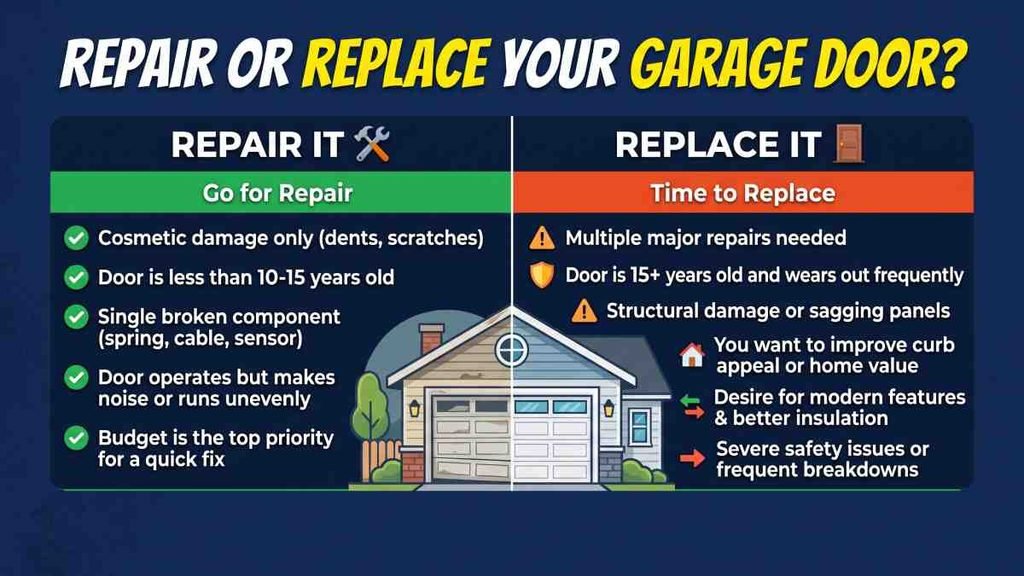
Use this to see which way a situation usually leans. Then ask a technician to confirm.
| Situation | Leans toward repair | Leans toward replacement | Ask a technician first |
|---|---|---|---|
| One dented section | Shallow dent, door moves evenly | Section is creased or cracked | Is the section structurally sound? |
| Several damaged sections | Rarely | Damage on multiple sections | Quote repair and replacement side by side |
| Rust | Limited to one small area | Spread across sections or into hinges and track | How deep does it go? |
| Warped or bent frame | Rarely | Door no longer travels evenly | Can the track and frame be straightened? |
| Noisy or shaking door | Worn rollers or hinges | Noise plus other failing parts | What is causing the noise? |
| Door off track | Track is straight, rollers intact | Track bent or sections damaged | Was the cause impact or wear? |
| Broken spring | Spring pair replaced | Spring plus other worn parts | Are both springs and the cables checked? |
| Opener failing | Clear, limited fault | Old opener or failed safety test | Does it meet the current standard? |
| Older opener without safety features | Rarely | Usually | Does it reverse on a 2×4 test? |
Note: This table shows general leanings, not a diagnosis. A technician’s inspection decides each case, and prices come from the participating company’s written quote.
A noisy garage door isn’t a sign it needs replacing on its own. Noise is often a worn roller or hinge. It becomes a replacement signal only when it comes with other failing parts.
What stays professional-only either way

Springs, lift cables and bottom brackets stay professional-only, whether you repair or replace. DASMA calls springs “arguably the most important and most dangerous part of your door.” It says cables should be “replaced only by a trained technician,” and that bottom brackets “should be adjusted or loosened only by a trained door systems technician.”
- Springs: they store the force that lifts the door, and a slipped tool or a snapped spring can cause serious injury.
- Lift cables: they stay under spring tension even when the door looks still.
- Bottom brackets: they anchor the cable to the door, and loosening one releases that tension.
DASMA advises replacing both springs when a door has two, and says extension springs need a safety cable. For all of this, DASMA’s garage door safety tips are a good reference before you decide anything about springs.
Call a professional right away if:
- The door binds or sticks. CPSC says doors that bind, stick, or aren’t balanced should be serviced by a professional.
- The door is crooked or off its track. The sections and rollers are carrying load they weren’t built for.
- A cable looks frayed or loose. It’s under tension, and a failure can drop the door.
- The opener fails the 2×4 test. The door may not reverse on a person or object.
Dallas conditions that tilt the decision
Two things shape this decision in Dallas: the age of many homes and what happens after storm damage.
On age, Point2Homes reports a median Dallas build year of 1981. Original doors and openers from that era may lack reversing systems and entrapment protection. That doesn’t mean yours needs replacing, but it’s a reason to run the 2×4 test.
On storm damage, a garage door repair after hail or wind may raise an insurance question. The Insurance Information Institute’s guide to the standard HO-3 policy lists windstorm and hail among covered perils. It also notes that areas prone to hailstorms may carry a separate hail deductible, and it advises asking your agent about it. That guide doesn’t discuss garage doors specifically, so ask your agent how your policy treats garage door damage and what deductible applies.
Photograph the damage before anything is moved or repaired, and keep the written quote.
What actually moves the cost (factors only)
This guide doesn’t quote prices, because they depend on your door, your parts and the company. These are the factors that move a quote:
- How many parts are failing. Each added part adds parts and labor.
- One spring or a pair. DASMA says to replace both when a door has two.
- Door size and weight. Larger and heavier doors take more material and labor.
- Opener type. Chain, belt and screw-drive units differ.
- Track and hinge condition. Worn hardware adds to the job.
- After-hours calls. An urgent call outside business hours can change the quote.
For ranges, see our page on garage door repair costs in Dallas. If the opener is the open question, the page on opener replacement costs covers that side.
Does replacing a garage door increase home value? The Cost vs. Value 2025 report from Zonda Media (its 38th edition) ranked garage door replacement first among the 28 projects it evaluated. For a 16×7-foot door with the existing opener reused, it reported a national average cost of $4,672, an estimated resale value of $12,507, and 268% of cost recouped.
Read that carefully. Those are national averages for one defined project, not a Dallas price or a promise about your house. The report gives no Dallas figure.
What to tell and ask the company
When you call, be specific. The more exact your description, the better the written quote.
- Describe the symptom and the door’s age. Why it matters: The company can tell whether to expect a spring, a track or an opener problem.
- Ask for a repair option and a replacement option in writing. Why it matters: Without both, you can’t compare.
- Ask what the garage door replacement estimate includes. Why it matters: Parts, labor, and removal of the old door should be itemized.
- Ask whether the springs, tracks and opener will be inspected. Why it matters: A repair that skips a worn partner part tends to come back.
- Ask what warranty covers parts and labor. Why it matters: Terms and exclusions vary, so get them in writing.
- Ask for the garage door repair quote before work starts. Why it matters: You can’t hold anyone to a price they only gave you by phone.
Door stuck right now? Call, describe the problem, and ask for a written quote before work starts.
Dallas Garage Door Fix is a homeowner resource that connects you with a participating local garage door company. We don’t perform the repairs ourselves, and we may receive a referral fee from participating companies. Response times and prices are set by the company that takes your call.
Frequently asked questions
It depends on which part is failing, not only on age. One damaged section, one failed spring pair, or a limited opener fault usually points to repair. Several failing parts, structural damage, or an old opener without safety features usually points to replacement. For any repair or replace garage door decision, ask the company to quote both options in writing.
In many cases, yes. A single damaged section can often be replaced without replacing the whole door, provided the rest of the door is sound. Whether it makes sense depends on the other sections and the hardware, so ask the company to inspect the whole door before quoting.
Yes, if your door has two springs. DASMA says to replace both, even if one is not broken. Springs wear together, so a surviving spring is often close behind. Spring work is professional-only because of the stored tension.
Repair a limited fault, such as a failed logic board or a remote that won’t pair, and replace an old opener that lacks modern safety features. CPSC recommends replacing older openers with ones that meet the federal standard. You can replace the opener without replacing the door.
No source gives one honest number. Age matters because of what it does to springs, hardware and openers. DASMA says older doors should have their springs inspected by a professional. Reversing systems have been required on openers since 1991, so an opener older than that is a replacement candidate.
A shallow dent on an otherwise sound door can often be repaired. A creased section, a bent track or a door knocked off its rollers is more serious. After a car impact, stop using the door and have a technician inspect the track, sections and hardware before anyone decides.
It may be, if the damage came from a covered peril. The Insurance Information Institute lists windstorm and hail as covered perils under the standard HO-3 policy, and says some areas carry a separate hail deductible. Its guide doesn’t address garage doors specifically, so ask your agent about your policy and deductible.
Not always. Whether the existing tracks can be reused depends on their condition and on the new door’s size and weight, which a technician has to inspect. Ask the written quote to say whether the tracks are included or reused.
It may. The Cost vs. Value 2025 report from Zonda Media ranked garage door replacement first of 28 projects, with a national average of 268% of cost recouped. That is a national average for one defined project, not a Dallas figure or a guarantee for your home.
Conclusion
Whichever way the repair or replace garage door question lands for you, the next step is the same. Describe the symptom, say how old the door is, and ask for a repair option and a replacement option in writing before any work starts. If your door also won’t open, read our guide to a garage door that won’t open first. You can also start from the Dallas Garage Door Fix homepage.
Ready to talk to someone? Call, describe the problem, and ask for a written quote before work starts.
Dallas Garage Door Fix is a homeowner resource that connects you with a participating local garage door company. We don’t perform the repairs ourselves, and we may receive a referral fee from participating companies. Response times and prices are set by the company that takes your call.
Last Updated: October 2026. Spotted something out of date? Tell us through the Contact page.