
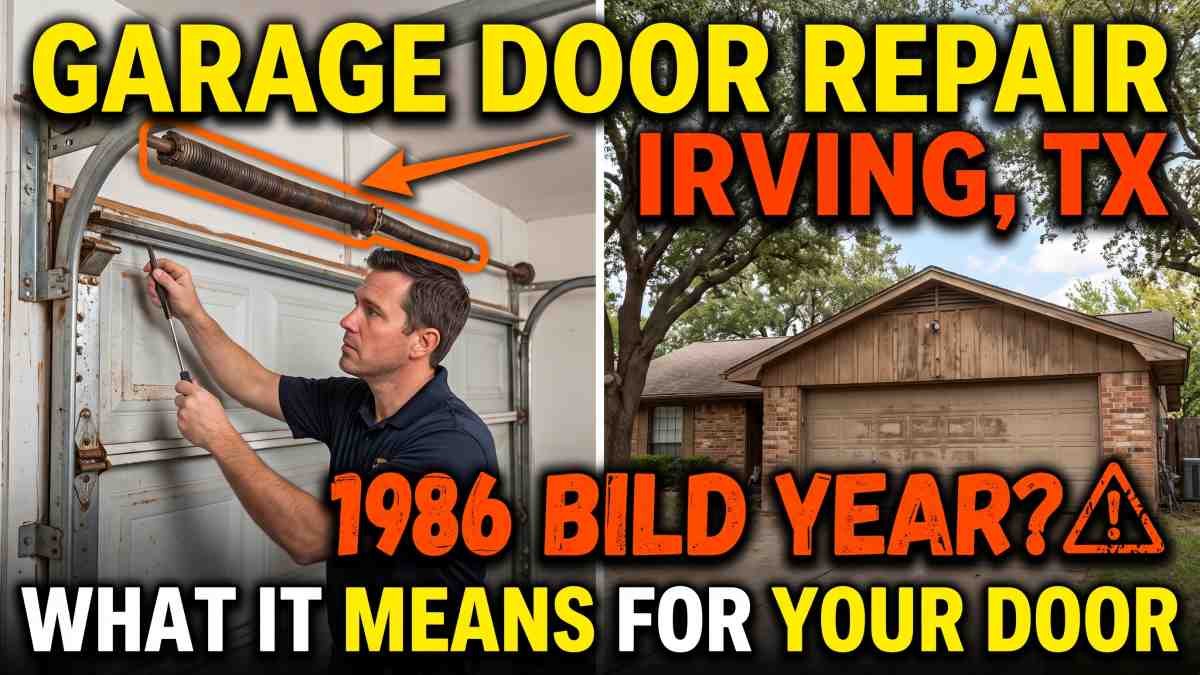
Age explains a lot of garage door trouble in Irving, and the numbers show why. Half the homes here predate 1986, so original springs, cables, rollers and openers have often run past their rated life. If you searched garage door repair Irving TX, this page covers symptoms, safe checks and what to ask.
That 1986 figure is the median year built, reported by Point2Homes from 2019–2023 American Community Survey estimates. By its decade breakdown, about 59% of Irving homes predate 1990. This page covers residential doors; commercial and loading-dock work is a different job.
Original Springs Don’t Last 40 Years: How Irving’s Older Doors Wear Out
A garage door spring is built for a set number of open-and-close cycles, not a set number of years. A1 Garage’s published guidance puts standard springs at about 10,000 cycles, roughly 7 to 10 years for most homes, and high-cycle springs at about 25,000. At four trips out and back a day, 10,000 cycles last under seven years.
Neighboring Grand Prairie splits closer to even, with about 48% of homes built before 1990 (Point2Homes, our sum), and our Grand Prairie garage door repair page covers how opener age fits into that.
Springs and cables: parts with a cycle count

Your door’s weight rides on springs, not the opener. Torsion springs sit on a bar above the door; extension springs run alongside the horizontal tracks. Either type weakens with every cycle until metal fatigue ends in a break.
Lift cables wind onto cable drums as the door rises, and a frayed cable lets one side sag. If a spring has already let go, garage door spring repair in Dallas explains what a correct repair looks like.
A broken spring is often mistaken for a dead opener. The opener hums or strains, but it was never built to lift the door by itself.
Rollers, tracks and hinges: the slow wear
Rollers wear, hinges loosen and the track drifts out of line. You hear scraping first, then see a door that rides crooked.
Owner, Tenant or Property Manager: Who Calls and Who Approves
Your lease or deed, not the door, decides who arranges and pays for a repair. Point2Homes reports 61.9% of occupied Irving housing units are renter-occupied (2019–2023 estimates), so the decision often sits with someone other than the resident.
If you rent
Report the problem in writing the same day, and describe the symptom without touching anything. Say so if the door won’t close, reverses or hangs crooked, because that is a safety issue. Check your lease before hiring anyone yourself.
If you own or manage the property
Triage by risk: a broken spring, frayed cable or door that won’t reverse comes before a noisy roller. For garage door repair for rental properties and property management work, keep itemized quotes.
What Your Door Is Doing, and What It Usually Means
Most symptoms point to springs and cables, tracks and rollers, the opener, or the safety sensors. Match what you see and hear to one before you call.
Won’t open, or stuck closed
Usually it’s one of three things: no opener power or a dead remote battery, an engaged manual lock bar, or a broken spring or cable. If the opener hums while the door barely lifts, think spring. A crooked lift points to a cable.
Opens halfway, then stops
The door is often hitting a limit setting, a force setting, an obstruction or a balance problem. Limit settings tell the opener where “open” is. A binding roller or weak spring can make it think the door hit something.
Won’t close, or reverses
When the door reverses, the safety system is doing its job. Photo-eye sensors sit near the floor on both sides, and a dirty, bumped or blocked one stops the door from closing. Check them before blaming the opener.
Loud, shaking or uneven
Scraping and rattling often mean worn rollers and loose hinges. Shaking points to a track or balance problem. A door higher on one side has a cable or spring problem, so stop using it.
Need a diagnosis? Call, describe the problem, and ask for a written quote before work starts.
Dallas Garage Door Fix is a homeowner resource that connects you with a participating local garage door company. We don’t perform the repairs ourselves, and we may receive a referral fee from participating companies. Response times and prices are set by the company that takes your call.
Three Parts You Never Touch, and Five Checks You Can Do Today
The three parts to leave alone are springs, cables and bottom brackets, because each holds the door’s weight under tension. On DIY versus professional work, the line is simple: remotes, lenses and tracks are yours, tensioned parts are a technician’s.
Five checks that are safe from the floor
- Power and remote. Check the plug, breaker and remote battery, and try the wall button.
- Lock bar. Make sure the manual lock isn’t engaged.
- Photo-eyes. Wipe both lenses and look for steady lights. The U.S. Consumer Product Safety Commission says an electric eye belongs 4 to 6 inches above the floor, so look for one knocked out of line.
- Track. Look for debris, a dent or a roller out of place. Look, don’t pry.
- Spring and cables. From a distance, look for a gap in the coil or frayed strands. Touch neither.
Springs, cables and bottom brackets: leave them
The Door & Access Systems Manufacturers Association calls springs “arguably the most important and most dangerous part of your door”. Its guidance is that frayed cables and the bottom brackets, which hold spring tension, should only be handled by a trained door systems technician. If your door has two springs, replace both, even if only one has broken.
Stuck shut with the car inside
Start with the five checks. If power and sensors are fine and the door still won’t move, stop. The red emergency release cord disconnects the opener, but it doesn’t make a damaged door lighter.
If you see a gapped spring or frayed cable, don’t lift the door by hand. Call, say the car is inside, and ask about options.
Stuck door right now? Call, describe the problem, and ask for a written quote before work starts.
Dallas Garage Door Fix is a homeowner resource that connects you with a participating local garage door company. We don’t perform the repairs ourselves, and we may receive a referral fee from participating companies. Response times and prices are set by the company that takes your call.
What a Proper Repair Visit Involves, Step by Step
A thorough visit follows a fixed order: secure, diagnose, repair, test. This describes a careful visit in general, not any one company.
- Secure the door and cut opener power.
- Diagnose the whole system, from torsion system inspection to springs, cables, drums, rollers, tracks, hinges and opener.
- Check balance. A balanced door held halfway open stays put; one that drifts has a spring problem.
- Replace or adjust the failed parts, springs in pairs on a two-spring door.
- Lubricate moving parts and reset the opener’s travel limits and force settings.
- Run the reversal and photo-eye tests, and show you the result.
How long it takes depends on what failed and which parts are on hand, so ask for a window rather than a promise.
Reading a Repair Quote: The Six Things That Set the Total
What decides the price of garage door repair? Six factors set the total: how many springs need replacing, door size and weight, spring cycle rating, other worn parts, opener brand and parts availability, and the timing of the call. Ask for a written quote that itemizes parts and labor before any work starts.
No verified Irving price source exists, so this page lists factors, not dollar figures. For garage door repair Irving TX quotes, what repairs cost in Dallas goes deeper on each factor.
| Factor | Tends to raise it | Tends to lower it | Ask the company |
|---|---|---|---|
| One spring or a pair | Both replaced | One spring, one-spring door | Are you replacing both? |
| Door size and weight | Two-car, insulated or glass-panel | Single-car steel | Does weight change the spring size? |
| Spring cycle rating | High-cycle (about 25,000, per A1 Garage) | Standard (about 10,000) | Which rating are you quoting? |
| Other worn parts | Cables, drums, rollers replaced too | Only the failed part | What else did you find worn? |
| Opener and parts | Older opener, hard-to-find parts | Common parts in stock | Is the part in stock? |
| Timing | After-hours or urgent call | Scheduled visit | Does a service call fee apply? |
Note: This table lists factors only. No verified Irving price source exists, and prices are set by the company that takes your call.
Dented, Hit or Worn Out: Fix the Panel or Replace the Door?
Replace one panel when the damage stays in that section and a matching panel exists. Replace the door when damage runs through the sections or tracks. Steel, wood, aluminum, insulated and glass-panel doors differ, so ask whether a matching panel is still available.
Stormersite lists 113 hail reports within 10 miles of Irving since 2004, which shows how often hail has passed through, not what will hit your street. Dented panels mark repair after storm damage, while a vehicle strike shows up in the track, so a door that scrapes or leans after a hit shouldn’t run on its opener.
Insurance depends on your policy, the cause and your deductible, so photograph the damage first. If the choice still feels unclear, repair or replace your garage door walks through the five questions that decide it.
The 1993 Opener Rule: Is Your Opener Older Than It?

Openers get replaced, so yours may be newer than the house. The U.S. Consumer Product Safety Commission explains the change in its final rule, issued December 3, 1992: automatic residential openers manufactured on or after January 1, 1993 must include entrapment protection, either an external sensor such as an electric eye or a constant-contact control button. If your opener may be older, ask whoever services it to confirm what protection it has. UL 325 is the name of the opener safety standard; this page relies on the CPSC rule because its date is verified.
How do you test a garage door’s auto-reverse? Lay a 2×4 flat on the floor in the door’s path and close the door. It should reverse when it touches the board. If it doesn’t, CPSC says to disengage the opener until it’s adjusted, repaired or replaced.
Repeat the test after every repair and about every 30 days, which matches CPSC’s advice to inspect the door and opener monthly. Then block the photo-eye beam while the door closes; it should stop and reverse.
On chain, belt or screw drive openers alike, force settings and travel limits control reversal, and turning the force up to stop reversals defeats the protection.
Permits and Deed Restrictions: What the City Says and What to Check Yourself
Does Irving require a permit to repair a garage door? The City’s residential permits page says permits are required to “repair a structure” but never mentions garage doors. That leaves the answer unclear, so ask the City’s Building Inspections Division before replacing a whole door, and ask your association about deed restrictions.
How Irving neighborhoods differ
The Irving Chamber of Commerce describes Las Colinas and Valley Ranch as deed-restricted. Deed restrictions can cover exterior changes, so read yours before changing a door’s style or color. For HOA garage door repair, ask whether a like-for-like fix needs sign-off.
| Area | What the Chamber says | What it means for your door |
|---|---|---|
| Las Colinas | Deed-restricted | Check before changing style or color |
| Valley Ranch | Deed-restricted, north of I-635 | Same |
| Heritage District | Irving’s birthplace; older and newer homes | Judge each door on its own age |
| Hospital District | A quiet, older section | Older homes raise the odds of worn parts |
| Northgate Heights | Affordable homes, tree-lined streets | No era given; check your home’s age |
Note: Descriptions come from the Irving Chamber of Commerce, which gives no construction eras by neighborhood, so this table makes no age claims.
Before You Say Yes: Six Things to Get in Writing
When you compare garage door repair Irving TX companies, get these six things in writing first.
- An itemized quote, parts and labor separate. Why it matters: you can compare line by line and spot add-ons.
- The service call fee and what it covers. Why it matters: surprise fees are hard to dispute.
- Proof of insurance. Why it matters: you’ll know who is responsible if something goes wrong.
- Parts and labor warranty terms. Why it matters: a verbal promise is hard to enforce.
- Spring type, cycle rating and whether both springs are replaced. Why it matters: standard and high-cycle springs wear differently, and DASMA advises replacing both.
- A reversal and photo-eye test after the repair. Why it matters: it proves the safety features still work.
Questions Irving Homeowners Ask Most
No verified Irving price source exists, so no number appears here. The total depends on the springs replaced, door size and weight, other worn parts and timing. Get an itemized written quote, and treat any price given before diagnosis as a guess.
Don’t try. Without the spring, the door’s full weight rests on the cables, the opener and whoever lifts, and DASMA calls springs “arguably the most important and most dangerous part of your door.” Call and ask what options exist for freeing a car.
Cycles. Each open-and-close flexes the spring until metal fatigue ends in a break, and A1 Garage puts standard springs at about 10,000 cycles, roughly 7 to 10 years. Replace a spring when it breaks, and replace both on a two-spring door, as DASMA advises.
It depends on the company that answers, because this site doesn’t dispatch crews or promise response times. Name the symptom, say it’s urgent, and ask for the earliest window. Ask whether after-hours work changes the quote.
It depends on your policy, the cause and your deductible. Storm damage may be covered, while age-related wear often isn’t. Photograph the damage first, then call your insurer before authorizing repairs.
Your lease decides, and 61.9% of occupied Irving units are renter-occupied (Point2Homes). Report the problem in writing and ask who approves the repair. Flag a snapped spring or failed reversal as a safety problem.
The City’s permits page never mentions garage doors, so don’t assume either way. Ask Irving Building Inspections whether your job needs a permit. Check deed restrictions or your association too.
Use the six-item list above: itemized quote, service call fee, proof of insurance, warranty terms, spring details and a reversal test. Each one guards against a different surprise. Compare line items, not totals.
Lay a 2×4 flat in the door’s path and close the door; it should reverse on contact. If not, disengage the opener until it’s fixed, per CPSC. Repeat after any repair, and block the photo-eye beam too.
Start with age and condition. Springs on a 1980s door have likely been replaced or are overdue, and an opener made before 1993 may lack required entrapment protection. Sound panels and tracks favor repair; widespread damage favors replacement.
DASMA recommends monthly checks by you and a yearly inspection by a trained door systems technician. A good one covers springs, cables, brackets, rollers, tracks, balance, the reversal test and photo-eyes. Contents vary, so ask for the checklist.
Calling From Irving: What Happens Next
You call, describe the symptom, and a participating local garage door company, or a service that connects callers with one, answers. This site doesn’t dispatch crews, employ technicians or set prices. Dallas Garage Door Fix is a homeowner resource that points you to a company.
Have the symptom and your opener’s age ready, and ask for a written quote before work starts.
Ready to talk to someone? Call, describe the problem, and ask for a written quote before work starts.
Dallas Garage Door Fix is a homeowner resource that connects you with a participating local garage door company. We don’t perform the repairs ourselves, and we may receive a referral fee from participating companies. Response times and prices are set by the company that takes your call.