
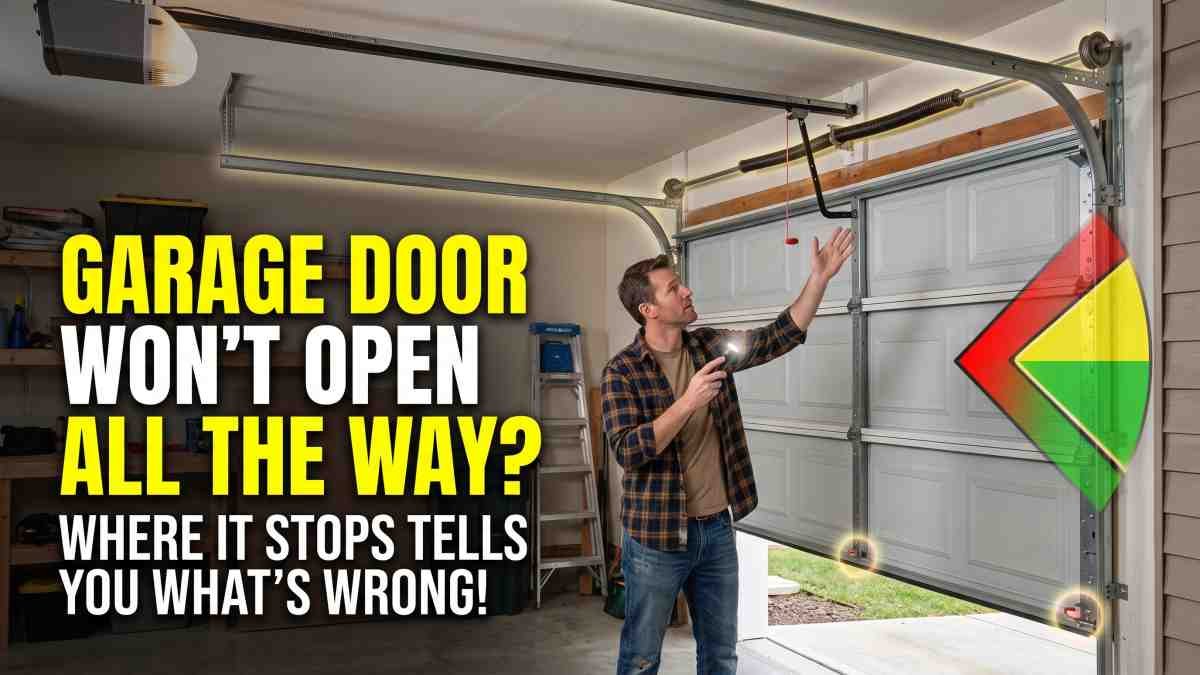
In short: A garage door won’t open all the way when the opener stops early, something in the track blocks it, or a spring has lost its lift. Check power, the remote and visible blockages yourself. Leave springs, cables and bottom brackets to a trained technician.
You press the button, the motor hums, and the door climbs a few feet before it quits. Or it stops at the same height every time, or starts up and then slides back down. Each of those tells you something different about the cause. This guide explains why a garage door won’t open all the way, what you can safely check from the floor, and where the line sits between a homeowner check and a technician’s job.
Stops, hesitates or reverses: what each pattern points to
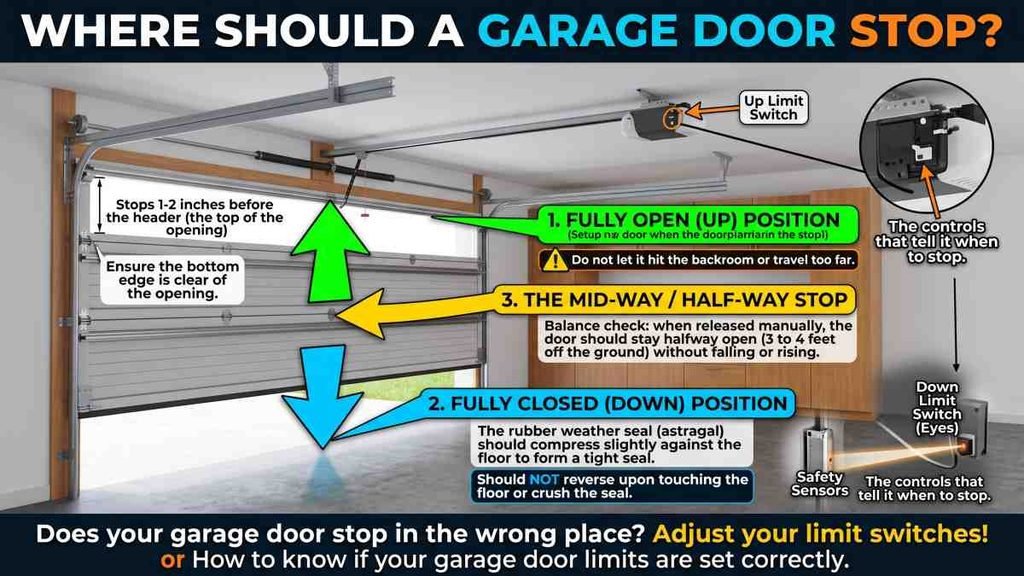
Where your door stops and what you hear point to the cause. A door that rises a few inches and quits is often fighting resistance. A motor that runs while the door barely moves can mean the door’s weight isn’t being lifted. A door that climbs and then slides back down may be reacting to force or binding.
Run through the table before you touch anything. It takes a minute, and it tells you whether to open your opener manual or pick up the phone.
| What the door does | What you may hear | What it may point to | Who handles it |
|---|---|---|---|
| Rises a few inches, then stops | Strain, a groan or a click | Resistance from a spring, track or hardware, or a low force setting | Technician for springs and hardware; owner’s manual for settings |
| Stops partway, same height every time | Normal motor sound, then quiet | The opener’s up-limit setting, or something fixed in the path | Owner’s manual for the setting; technician if it’s the track |
| Climbs, then reverses | The motor sound changes | Force setting or binding in the path | Owner’s manual; technician if the door binds |
| Motor runs, door barely moves | Humming, whirring or grinding | A lifting problem: a spring, or the opener drive not gripping the door | Technician |
| Stops and clicks | Repeated clicking | The opener itself, or a loose part | Technician |
Note: These are patterns, not diagnoses. Causes overlap, so use the table to decide where to look first.
Pay attention to three things: the height where it stops, whether that height is the same every time, and what the motor sounds like. A technician can use all three, so write them down.
Opener or door? A hand test that separates the two
A hand test separates opener trouble from door trouble. With the opener disconnected, a healthy, balanced door stays where you leave it and moves without a fight. If it feels heavy, drops or binds, the door is the problem. If it moves easily, the opener’s settings or drive are the likelier cause.
The U.S. Consumer Product Safety Commission explains that a properly balanced door stays in place when stopped in any partly open position, and that a severely unbalanced door could crash to the floor. In its garage door opener safety guide, the agency says doors that are not balanced, or that bind or stick, should be serviced by a professional.
That crash warning is why the test comes with rules:
- Skip the test if the door is stuck partway up. Don’t disconnect the opener, and keep people, pets and cars out from under it.
- Start with the door fully closed. Disconnect the opener from the door with its quick-release, following your manual.
- Lift the door slowly by hand. It should rise without a fight. If it feels very heavy at any point, stop and don’t force it.
- Check whether it holds. Stop the door partway and see whether it stays put. Keep your hands and feet away from the bottom edge and the tracks.
- Reconnect the opener the way your manual describes.
If the door moves freely by hand but not with the opener, the problem sits on the opener side. If it’s heavy, drops or binds, the weight-lifting system is the suspect, and that belongs to a technician.
Travel limits, force settings and why the opener stops early
An opener stops early when its limit setting says the door is already at the top, or when its force setting makes it quit against resistance. Both settings live on the opener, not on the door. Your owner’s manual shows where they are and how to change them.
If your garage door won’t open all the way and the track and sensors look clear, the limit setting is the first thing to rule out.
Limit set too low
The travel limit tells the opener where to stop. Set too low, it ends the cycle early. The motor sounds normal, and the door stops at the same height every time.
Force setting
The force setting controls how hard the opener pushes before it quits. Don’t turn it up to muscle a stiff door open. A door that needs more force usually has a mechanical problem, and the instructions required by federal rule (16 CFR §1211.16) warn that failing to adjust an opener properly may cause severe injury or death.
After a repair, a release or a new installation
If the problem started after an installation, a repair, or after you released the opener by hand and reconnected it, the settings are the first suspect. Follow your opener’s manual for any change. Then retest: the same federal rule says to retest the opener after adjusting force or limits, and the door must reverse on contact with a 1½-inch object or a 2×4 laid flat.
If the settings look right and the motor still stops short, the opener itself may be at fault. A technician can check it, and garage door opener repair in Dallas explains what that visit covers.
Safe checks first, in this order

Power and remote problems usually stop a door completely rather than partway, but ruling them out takes a minute. Work through these in order, and stop the moment something looks damaged.
- Power. Check that the opener is plugged in and the outlet or breaker has power. What it means: with no power nothing moves, so a partial stop points elsewhere.
- Wall button, remote and keypad. Try each one. What it means: if the wall button opens the door further than the remote does, the remote or its battery is the problem. If all of them stop at the same spot, look at the door or the opener.
- Photo-eye sensors. Wipe both lenses, make sure nothing blocks them and that they face each other. CPSC says electric eyes should sit 4 to 6 inches above the floor. What it means: sensors guard the closing path, which makes them a long shot for a door that stops going up, but this is a two-minute check. If one looks damaged or won’t stay aligned, garage door sensor repair in Dallas shows what a technician looks at.
- The opener rail and both tracks. Look along them for anything in the way. What it means: a stray object or debris can stop the carriage or a roller.
- The lock and the carriage. Look, don’t force. Is the manual lock engaged? Has the carriage come apart from the door? What it means: an engaged lock or a detached carriage stops the door from lifting.
Tracks, rollers, hinges and panels: what to look at, what not to force
A bent track, stuck roller or binding panel can stop a door by adding friction the opener can’t overcome. You can spot most of these by eye. DASMA, the garage door industry association, treats a door that doesn’t travel smoothly as a possible unsafe condition, so don’t write it off as an annoyance.
What to look at:
- Tracks: dents, gaps, or a track pulled away from the wall.
- Rollers: one that has popped out of the track or wobbles badly.
- Hinges and hardware: loose, bent or cracked pieces.
- Panels: a cracked or warped section that catches as it rises.
- Bottom seal: rubber caught on the floor or on a track.
What not to do: don’t hammer a track straight, don’t pry a roller back in, and don’t keep pressing the button while something is jammed. That keeps loading the opener and the stuck part. A roller out of the track or a bent track is a job for off-track garage door repair.
Springs, cables and bottom brackets: leave these to a technician
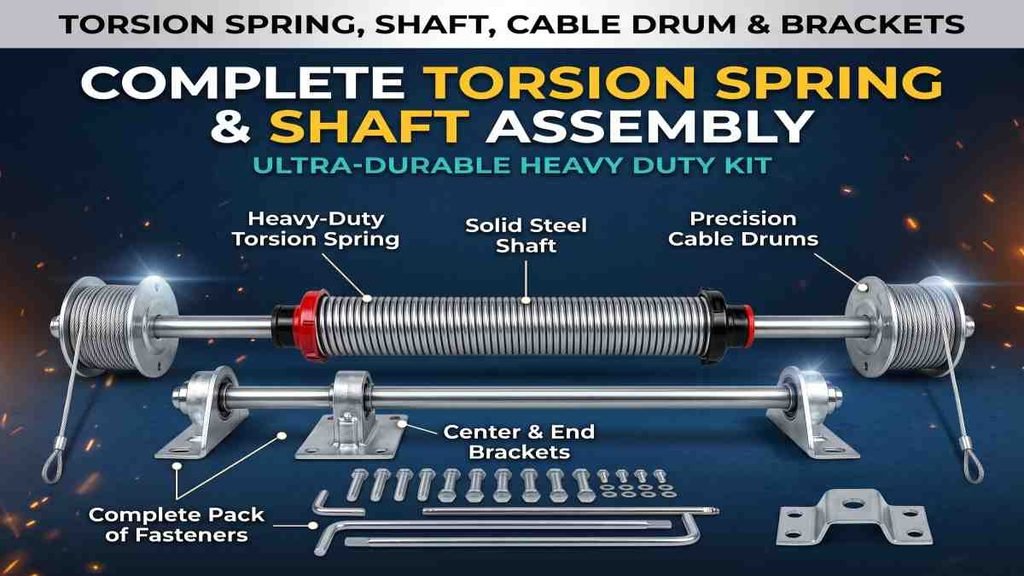
A broken or weakened spring can stop a door from opening fully, and it’s the one cause you should never fix yourself. Torsion and extension springs carry the door’s weight. When one breaks or weakens, the opener has to lift the full load, and it may stop early or strain. Springs, lift cables and bottom brackets are under extreme tension and belong to a trained technician.
DASMA, the Door & Access Systems Manufacturers Association, says garage door spring systems are dangerous and should be repaired only by trained professionals. Its garage door safety tips also say lift cables should be replaced only by a trained technician, that bottom brackets should be adjusted or loosened only by a trained door systems technician, and that a door that does not go up and down smoothly may be an unsafe condition.
The federal opener instructions say the same thing in plain terms: have a qualified service person make repairs to cables, spring assemblies and other hardware.
You can look without touching. These signs point to a spring or cable problem:
- The door feels very heavy when the opener is disconnected.
- You can see a gap in the spring coil above the door.
- A lift cable looks frayed or has slipped off its drum.
- The door hangs crooked.
If you’re curious what a spring visit involves, garage door spring repair in Dallas walks through it.
Broken spring or bad opener? How to tell them apart
A broken spring makes the door heavy by hand, while a bad opener leaves the door light but unmoved. That difference is why a failed spring is so often mistaken for a failed opener. The motor strains, the door barely lifts, and it looks like the opener gave out.
| Clue | Points to a spring or door problem | Points to an opener or settings problem |
|---|---|---|
| Door by hand, opener disconnected | Heavy, drops or binds | Moves easily |
| Sound when opening | Strain as the door barely lifts | Normal motor sound, then it stops |
| Where it stops | Varies, or barely moves | Often the same height every time |
| What you can see | Gap in the coil, frayed cable, crooked door | Nothing visibly wrong |
| When it started | After wear, or a snap you heard | After installation, reprogramming or a release |
Note: No single clue settles it. Use two or three together, and call a professional if the door fails the hand test.
Two other mix-ups are common. A sensor problem mostly affects closing, while a limit problem stops the door on the way up. A bent track tends to scrape and catch at the same spot, while a worn roller tends to rattle and move unevenly.
Older Dallas homes and older openers
Older Dallas homes often come with older door hardware and older openers. Point2Homes, using Census-based figures, reports that the median Dallas home was built in 1981. So some Dallas garages may still run an opener installed before federal rules added external entrapment protection, such as photo-eyes, in 1993, according to the U.S. Consumer Product Safety Commission.
That matters for two reasons. An opener that old may lack current safety features, and an old opener that has started to misbehave is a reason to weigh repair against replacement, covered below.
When to stop and call, and what to tell the company
Stop and call a professional when the door is stuck partway, feels heavy or drops, shows a gap in a spring or a frayed cable, or still won’t open fully after the safe checks. Each of these has a reason:
- Stuck partway up: a partly raised door may be unbalanced, so don’t stand under it or disconnect the opener.
- Heavy by hand or dropping: CPSC says doors that aren’t balanced should be serviced by a professional.
- A gap in the coil, a frayed cable or a crooked door: these parts are under tension (DASMA).
- The settings look right but it still stops short: the opener or its control board may be at fault.
- The door binds or sticks: CPSC lists this as a professional job too.
When you call, describe the problem plainly. Something like “my garage door won’t open all the way and stops about halfway” gives a dispatcher the right starting point. Then be ready to share these details, and notice why each one matters:
- Where it stops and what it does (stops, reverses, hums). It narrows the cause before anyone arrives.
- What you heard (grinding, clicking, a bang). Sounds separate drive trouble from spring trouble.
- What changed recently (a new opener, reprogramming, a repair). Settings problems often follow work on the door.
- Your door and opener type, if you know them. They affect which parts are needed.
- A written quote listing parts and labor before work starts. It prevents surprises on the day.
Cost depends on what’s found: whether a spring, cable or roller is worn, the door’s size and weight, the opener type, and the time of the call. The company that takes your call sets the price.
Door stuck right now? Call, describe the problem, and ask for a written quote before work starts.
Dallas Garage Door Fix is a homeowner resource that connects you with a participating local garage door company. We don’t perform the repairs ourselves, and we may receive a referral fee from participating companies. Response times and prices are set by the company that takes your call.
Repair the opener or replace it?
Repair an opener when the problem is a setting or a single worn part. Consider replacement when the opener is old, the same fault keeps coming back, or the opener is the only thing wrong with an otherwise healthy door.
Fix the door side first. A new opener on a door with a broken spring would strain the same way and stop early again. If the mechanical side checks out and the opener is the weak link, opener replacement cost in Dallas explains what drives that quote.
Keeping it from happening again
A short monthly check catches most problems early. CPSC says to inspect the door and opener every 30 days and test the reverse function with a 2×4 on the floor. DASMA recommends monthly safety checks and an annual visit from a trained door systems technician. After any change to force or limits, retest.
Frequently asked questions
The usual causes are an opener limit set too low, resistance from a track or roller, or a spring that has lost its lift. Start with the safe checks above: power, remote, sensors and anything in the path. If the door feels heavy by hand, stop there and call a technician.
It usually means the door met resistance almost at once. That can come from a weak or broken spring, a binding track or hardware, or a force setting that’s too low. Don’t force the door or raise the force setting. If it’s heavy by hand, the weight-lifting system needs a professional.
Yes. Springs carry the door’s weight, so a broken or weakened spring leaves the opener lifting a load it wasn’t built to carry alone. The door may rise a little and quit, or not move at all. Never repair a spring yourself, because DASMA says spring systems should be repaired only by trained professionals.
If the door moves freely by hand, its weight system is likely healthy, and the problem sits on the opener side. Check the limit and force settings in your manual, and look for a lock or a detached carriage. If those look fine, the opener’s drive or control board may need a technician.
Rarely. Photo-eye sensors guard the closing path, so a door that stops going up is seldom a sensor issue. They’re still worth a quick look, since CPSC says electric eyes should sit 4 to 6 inches above the floor. If one is damaged, have it checked.
The travel limit tells the opener where to stop at the top and bottom. Adjust it only as your owner’s manual describes, in small steps. Afterward, retest that the door reverses on a 2×4 laid flat. If you’re unsure, ask a technician.
It’s best not to use it until it’s checked. A door that doesn’t move normally may be unbalanced, and CPSC warns that a severely unbalanced door could crash down. Keep people and cars out from under it, and don’t try to force it open.
Yes. The federal opener instructions (16 CFR §1211.16) say to retest after adjusting force or limits. The door must reverse on contact with a 1½-inch object or a 2×4 laid flat. If it doesn’t reverse, stop using the opener automatically and get it serviced.
Cost depends on what’s found: a worn spring, cable or roller, the door’s size and weight, the opener type, and the time of the call. A setting adjustment costs less than a part replacement. Ask for a written quote listing parts and labor before work starts, since the company that answers sets the price.
Spotted something out of date? Tell us through the Contact page.
Ready to talk to someone? Call, describe the problem, and ask for a written quote before work starts.
Dallas Garage Door Fix is a homeowner resource that connects you with a participating local garage door company. We don’t perform the repairs ourselves, and we may receive a referral fee from participating companies. Response times and prices are set by the company that takes your call.
If you’d rather start from the beginning, the Dallas Garage Door Fix homepage lists the problems we cover.