
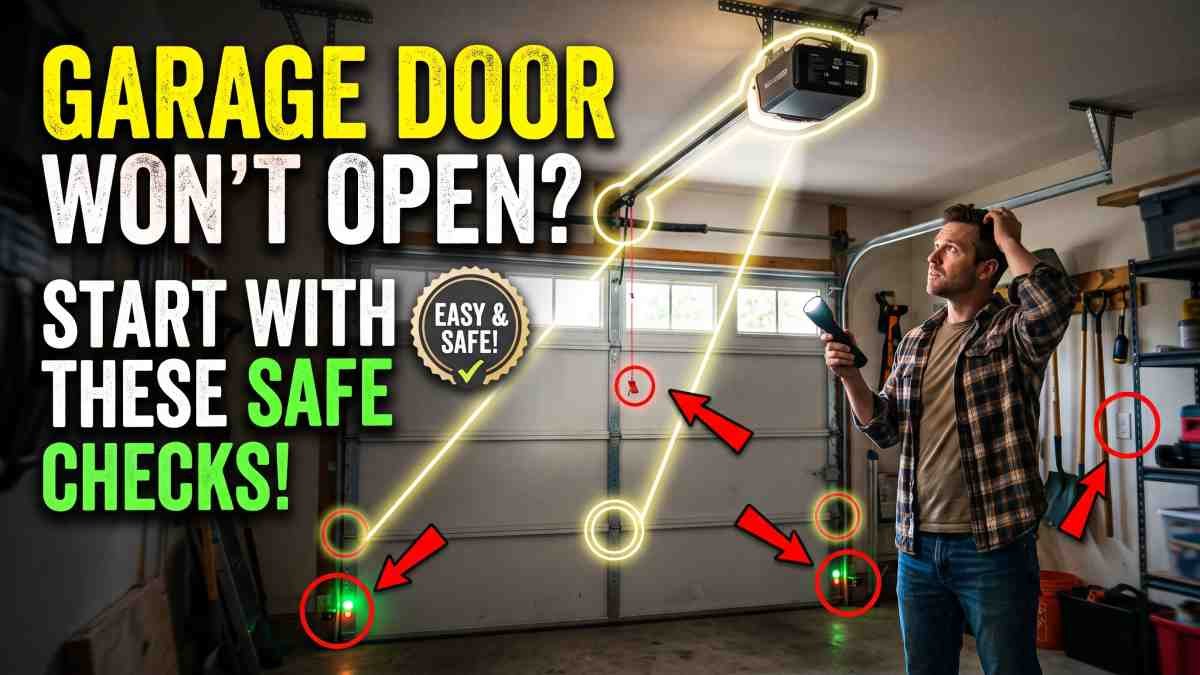
In short: When a garage door won’t open, the cause is usually power, the remote, a lock or disconnected release, or a broken spring. You can rule out the first three yourself in minutes. A heavy door, a loud bang or a visible gap in a spring means stop and call a professional.
You press the remote and nothing happens. Or the motor runs, the light comes on, and the door stays exactly where it is. Either way, the car is stuck and the day has stalled. When your garage door won’t open, the fastest fix is usually something simple, and the most dangerous mistake is guessing.
Four rules before you try anything
Four rules keep a stuck door from turning into an injury. Each comes from a named source, and each has a reason.
- Don’t force a door that feels heavy, sticks or won’t budge. Clopay, a garage door manufacturer, says not to try to force it open. Genie says that if a door is too heavy to lift by hand, you should avoid opening it manually and contact a professional.
- Pull the red emergency release only when the door is closed. Genie recommends this because the system is under the least pressure in that position. Home Depot’s troubleshooting guide warns that releasing an open door could let it come crashing down.
- Unplug the opener before you work near the motor head or the carriage. Genie explains that if power returns mid-task, the moving carriage can injure you.
- Leave springs, lift cables and bottom brackets alone. They store enough tension to hurt you, and the spring section below explains why.
What did the opener do when you pressed the button?
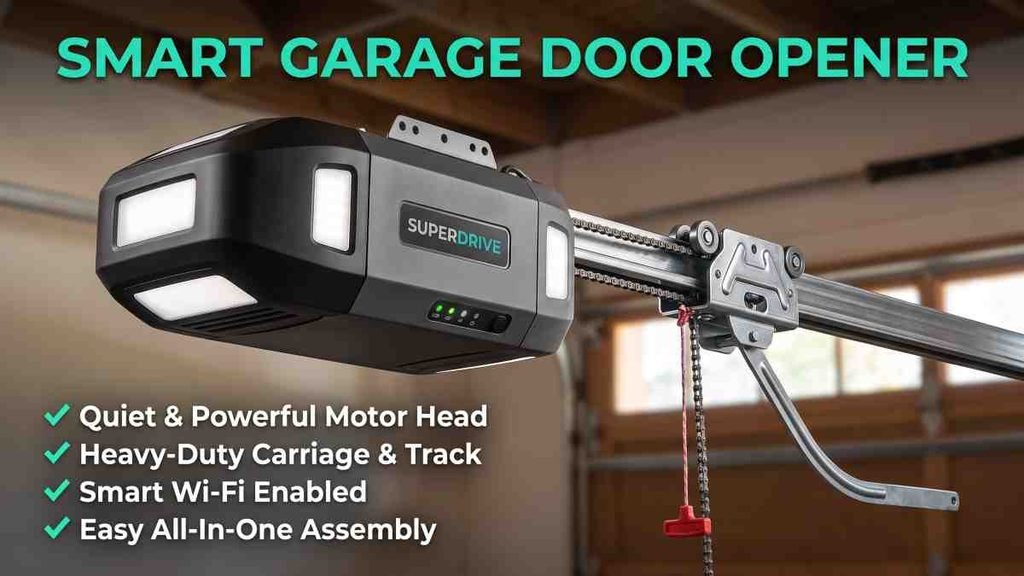
What the opener did is your best clue. Silence points to power or the remote. A running motor with a stationary door points to a disconnected release or a broken spring. A bang followed by nothing points to a spring.
| What you notice | What it often means | Where to look |
|---|---|---|
| No light, no sound at all | No power, a tripped breaker, or a damaged control board | Power checks below |
| Remote does nothing, wall button works | Remote battery, range, antenna, or a lock mode on the wall control | Remote checks below |
| Motor runs or hums, door stays put | The carriage is disconnected from the door, or a spring has broken | Emergency release and spring sections |
| A loud bang, then nothing | A broken spring | Spring section |
| Door rises a little, then stops | A different problem, covered in a separate guide | See the note below |
Note: This table points to where to look first. It doesn’t diagnose, and one symptom can have more than one cause.
If your door rises and then stops partway, that’s a different problem with its own checks. See our guide to a garage door that stops partway up.
Power, remote and lock: the five-minute checks
Power and remote problems cause more no-response doors than mechanical failures, and they cost nothing to rule out. Work through these in order, and note what each result means.
- The outlet and the breaker. Plug a lamp or tool into the opener’s outlet, as Genie suggests, and check that the circuit breaker hasn’t tripped. What it means: no power means the opener can’t move the door at all.
- The wall control, remote and keypad. Try each one. What it means: if the wall control works but the others don’t, the problem is with the remote or keypad, not the door. If none of them work, look at power or the opener.
- The remote itself. If your garage door won’t open with the remote, replace the battery, stand closer, and make sure nothing blocks the opener’s antenna. Reprogram the remote as your manual describes.
- A lock mode on the wall control. Genie notes that some wall consoles have a vacation or lock mode that disables the remote and keypad. What it means: the opener may be fine, and the console is simply telling it to ignore you.
- A manual lock on the door. Check that nobody slid a lock bar into place. What it means: a locked door can make the opener strain or stop to avoid overload.
The motor runs but the door doesn’t move: check the emergency release
A running motor with a door that stays put often means the carriage has come loose from the door. Genie explains that when the red emergency cord is pulled, the motor runs but the door doesn’t move. A bump, a child’s tug or a past power-out can leave the release disengaged.
Re-engage it the way your opener’s manual describes. Many openers click when the carriage reconnects. Do it with the door closed, and unplug the opener if you’ll be working near the carriage.
If you can’t tell whether the door is balanced, don’t lift it to help. A door that has lost its spring support can be far heavier than it looks.
Opening the door by hand, and when not to
Opening a stuck door by hand is a way to get the car out, not a repair. Do it only if the door is closed and the hardware looks intact. Genie’s guide to opening a garage door manually says to inspect the springs and hardware first, pull the red cord only with the door closed, and avoid opening the door manually and call a professional if it’s too heavy to lift. It also says to unplug the unit before working on the motor head or carriage.
- Look at the springs and hardware. If anything looks broken, stop here.
- Close the door and unplug the opener. Home Depot’s guide also says to unplug it first.
- Pull the red cord until the carriage releases.
- Lift slowly. Home Depot warns that too much force or speed can make a door spring up and slam back down.
- Stop if it’s heavy. Don’t force it.
- Check you have another way into the house before you leave the garage, as Genie advises.
With the opener disconnected, the door isn’t locked. Home Depot notes that it isn’t securely shut until you slide the lock bar by hand.
Broken spring or snapped cable: the signs and what to do

A broken spring can stop a door from moving at all. Torsion and extension springs carry the door’s weight. When one breaks, the opener faces the full load and usually can’t lift it. A snapped lift cable has the same effect.
Genie says a broken spring may sound like a firecracker or a gunshot. Clopay says that if a door doesn’t open smoothly, gets stuck halfway or won’t budge at all, it may have a broken spring, and you shouldn’t force it. You may also see a gap in the coil above the door, a frayed cable, or a door hanging crooked.
DASMA, the Door & Access Systems Manufacturers Association, advises that garage door springs, lift cables and bottom brackets are jobs for trained professionals. Its garage door safety tips say springs should be repaired only by trained professionals, cables replaced only by a trained technician, and bottom brackets adjusted or loosened only by a trained door systems technician.
If a spring is the culprit, garage door spring repair in Dallas shows what a technician’s visit covers.
After a storm or a surge: when the control board is the problem
Sometimes the opener itself fails, and not the door. Genie lists lightning or a power surge as a cause of a damaged circuit board. The signs it names are erratic operation, remotes or keypads that stop working, and opener lights that stay dark.
If the trouble began after a storm, mention that when you call. It points a technician toward the control board and saves time. Genie also suggests a surge protector to protect the opener in future. When the opener is the suspect, garage door opener repair in Dallas explains what that service involves.
Stuck shut with your car inside
If the door is closed, the car is inside, and the safe checks haven’t helped, don’t force it. Try the manual release only if the door moves easily and the hardware looks intact. If it’s heavy, or you hear or see a spring problem, call.
An urgent call is different from a routine one. Emergency garage door repair in Dallas explains what counts as an emergency and what to ask when you phone.
When to call, and what to tell the company
Call a professional when the door is heavy, a spring looks broken, you heard a bang, or the safe checks haven’t solved it. Here’s why each sign matters:
- The door is heavy or won’t budge: Clopay and Genie both say not to force it.
- You heard a bang or see a gap in the coil: spring tension is dangerous (DASMA).
- The motor runs and the release is engaged, but the door still doesn’t move: the weight system or the opener drive needs a technician.
- Remotes and keypads act erratically: the control board may be damaged.
When you call a Dallas company, describe it plainly: “My garage door won’t open, the motor runs, and the door doesn’t move.” Then share:
- What the opener did (silent, humming, running). It narrows the cause before anyone arrives.
- What you heard (a bang, grinding, nothing). Sounds separate spring trouble from opener trouble.
- What changed recently (a storm, a new remote, a repair). It points toward the control board or settings.
- Whether you pulled the emergency release. It tells them how the carriage was left.
- A written quote listing parts and labor before work starts. It avoids surprises.
Cost depends on what’s found: a spring, cable or control board, the door’s size and weight, the opener type and the time of the call. The company that takes your call sets the price. For what drives it, see garage door repair cost in Dallas.
Door stuck right now? Call, describe the problem, and ask for a written quote before work starts.
Dallas Garage Door Fix is a homeowner resource that connects you with a participating local garage door company. We don’t perform the repairs ourselves, and we may receive a referral fee from participating companies. Response times and prices are set by the company that takes your call.
Frequently asked questions
Start with the remote’s battery, the range and the antenna, then check whether a lock mode on the wall control is blocking it. Try the wall control too. If the wall control works and the remote doesn’t, the remote is the problem. If neither works, check power at the outlet and the breaker.
The carriage has probably come loose from the door, or a spring has broken. Genie explains that when the red emergency cord is pulled, the motor runs but the door doesn’t move. If the release is engaged and the door still won’t lift, a broken spring is the likelier cause, and that needs a technician.
Yes. Springs carry the door’s weight, so a broken one leaves the opener lifting more than it can. Clopay says a door that won’t budge may have a broken spring. Don’t force it, and don’t try to replace the spring yourself, because DASMA says spring systems should be repaired only by trained professionals.
Only when the door is closed, the hardware looks intact and the door moves easily. Genie recommends pulling the release cord only with the door closed and avoiding manual opening if it’s too heavy. If the door feels heavy or sticks, stop and call a professional.
The opener is working, so the problem sits with the remote. Replace its battery, check range and antenna, and reprogram it as the manual describes. If it still fails, the remote or the opener’s receiver may need replacing.
Yes. Genie lists lightning or a power surge as a cause of a damaged circuit board. Signs include erratic operation, remotes or keypads that stop working, and opener lights that stay dark. A technician can confirm whether the board or the whole opener needs attention.
A door that won’t close is often a sensor problem. Genie says the two sensors must be able to see each other, so wipe the lenses and make sure they face each other squarely. If the door still won’t close, the opener’s limit settings may need a technician to check them.
Cost depends on what’s found: a broken spring or cable, a damaged control board, the door’s size and weight, and the time of the call. A setting or a remote costs less than a part replacement. Ask for a written quote with parts and labor before work starts, since the company that answers sets the price.
Spotted something out of date? Tell us through the Contact page.
Ready to talk to someone? Call, describe the problem, and ask for a written quote before work starts.
Dallas Garage Door Fix is a homeowner resource that connects you with a participating local garage door company. We don’t perform the repairs ourselves, and we may receive a referral fee from participating companies. Response times and prices are set by the company that takes your call.
If you’d rather start from the beginning, the Dallas Garage Door Fix homepage lists the problems we cover.