
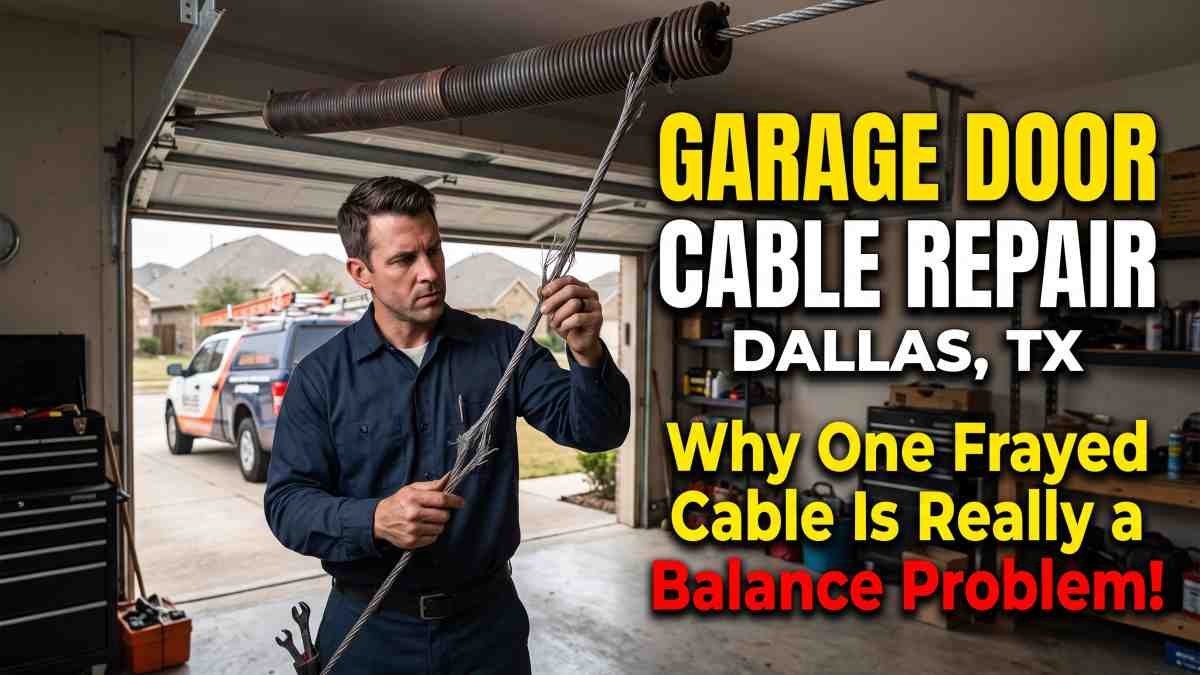
Your garage door hangs on two thin steel cables. They share the lifting load with the springs, so one bad cable tilts the whole door. Stop using the door and keep people clear. This guide explains garage door cable repair Dallas homeowners can plan for, from warning signs to cost factors.
Two cables, one load: how a failing cable tilts the whole door
A lift cable carries the spring’s lifting force to the bottom corner of your door, and you have one on each side. When one weakens, the other side takes more than its share and the door twists in the opening.
On a torsion-spring door, each cable runs from a bottom bracket up to a cable drum at the end of the spring shaft. The spring, the drum and the cable work as one load path. That’s why a cable problem is rarely only a cable problem.
According to the Door and Access Systems Manufacturers Association (DASMA), you should look over the cables that join the spring system to the bottom brackets, because frayed or worn cables can break and cause injury. DASMA also says only a trained technician should replace them. This page covers residential sectional doors; commercial and roll-up doors use different hardware.
Five signs of a cable problem, and what each one means
Most cable trouble shows from the driveway. Look first, and don’t touch the door.
Frayed or rusty cable

Split strands, a kink, or orange rust near the drum or bottom bracket mean the cable is wearing out. DASMA says worn cables can break, so treat a frayed cable as a stop-and-call problem, not a next-month job. A cable that snaps often does so with a loud bang, and the door can drop on that side.
Cable hanging loose or tangled
A cable dangling beside the door, or bunched up near the drum, has lost its tension. Possible causes include a cable that jumped its drum or a spring that failed. Either way, the door is no longer held evenly.
Cable off the drum or pulley
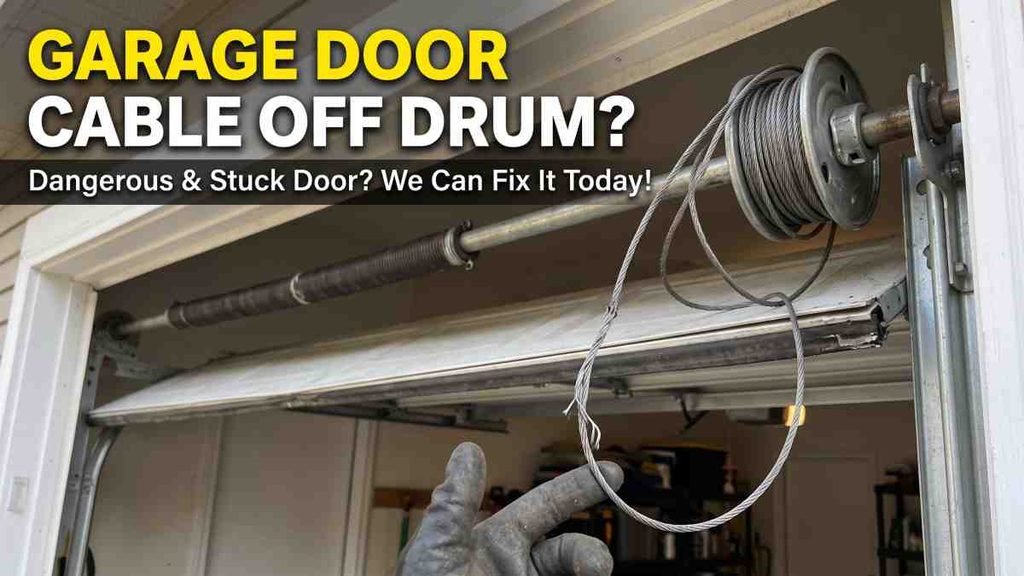
On a torsion door, the cable should sit in a groove on the drum. If it slipped off or wound over itself, one side loses its lift. On older extension-spring doors, check the pulleys at the top corners.
Door crooked or uneven on one side
One bottom corner sits lower than the other, or a section looks tilted. That points to a cable that has let go on one side. It can also push a roller out of its track.
Door stuck, won’t open or won’t close
If the opener hums and the door stalls, or the door won’t move at all, a cable may be slack or binding. Stop pressing the button. An opener isn’t built to drag a door that’s out of balance.
Need a diagnosis? Call, describe the problem, and ask for a written quote before work starts.
Dallas Garage Door Fix is a homeowner resource that connects you with a participating local garage door company. We don’t perform the repairs ourselves, and we may receive a referral fee from participating companies. Response times and prices are set by the company that takes your call.
Why cables fail in Dallas homes
Cables fail from wear, from a part that’s out of alignment, or from a sudden jolt. These are the causes you can see or feel.
Wear at the drum, and cables that keep failing
Every trip up and down winds the cable over the drum. If a cable keeps coming off the drum, or keeps breaking repeatedly, the cable may not be the real problem. Trusty Garage Door Repair reports a drifted drum, a worn bearing and a failed spring among the common reasons, so a good company finds the cause before hanging a new cable.
Rust and fatigue
Steel strands rust and fatigue with use, which is why DASMA tells owners to check cables by eye. Rust near a bracket or drum is a warning sign, not a cosmetic issue.
Impact and storm season
A bumper tap to a lower corner can jar a cable loose, and so can storm debris. North Texas severe-weather season runs from mid-March through June, according to Harold Brooks of NOAA’s National Severe Storms Laboratory, quoted by the Fort Worth Star-Telegram. If your door took a hit in spring, have the cables checked, not just the panels.
Older doors
Dallas’s median home was built in 1981, reported by Point2Homes using Census data. If the door and hardware in a home that age are original, the cables have decades of cycles behind them. DASMA suggests monthly checks by you and an annual visit from a trained technician.
Cable or spring? The mix-up that sends people to the wrong fix
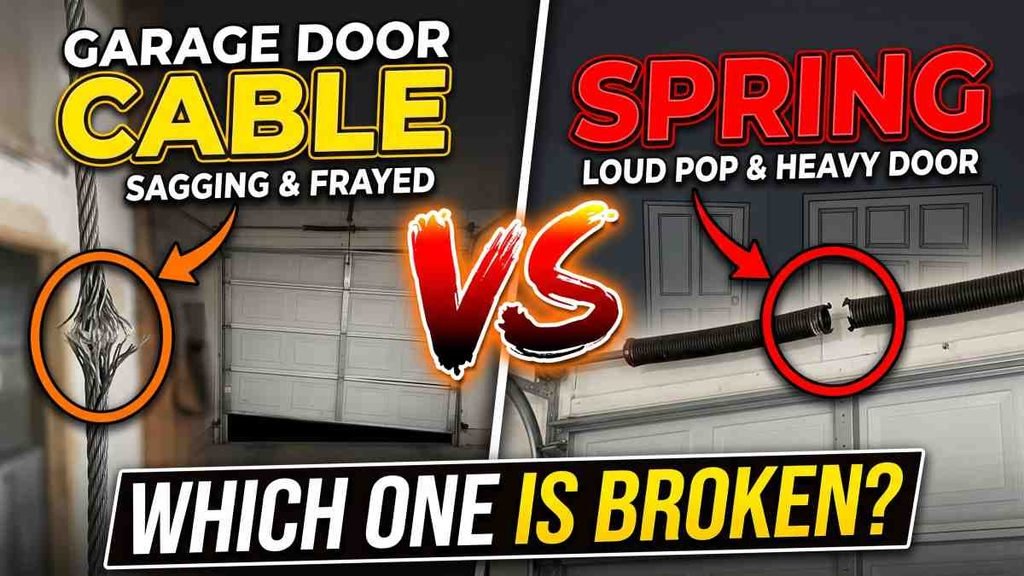
To tell a cable problem from a spring problem, look at how the door sits. Trusty Garage Door Repair reports that a failed cable usually leaves the door lopsided or dragging on one corner, while a broken spring leaves the whole door heavy and reluctant to lift. Symptoms overlap, so a technician should check both.
| What you see | Likely cable | Likely spring | Likely track or roller |
|---|---|---|---|
| One bottom corner sits lower | Likely | Possible | Possible |
| Door feels very heavy or won’t lift | Possible | Likely | Less likely |
| Cable visibly loose or hanging | Likely | Possible | Less likely |
| Scraping or binding on one side | Possible | Less likely | Likely |
| Roller outside the rail | Possible | Less likely | Likely |
Note: These are patterns, not diagnoses. A broken spring can pull a cable off its drum, and a loose cable can push a roller out of its track, so a technician should inspect all three.
That overlap is how a spring failure can fool you. Trusty reports that a spring failure can shock-load a cable and pull it off the drum, so the cable looks guilty when the spring started it. If a spring failed, our guide to garage door spring repair in Dallas covers that side.
If a slipped cable has already pulled the door out of its rail, you’re also looking at garage door off track repair in Dallas. A worn roller or bent track can mimic a cable problem, but those are separate repairs. A whole new door only comes up if the fall damaged panels, so ask a company to explain before you agree.
Extension-spring doors: pulleys and safety cables
Older doors often use extension springs stretched along the horizontal tracks, with cables and pulleys at the top corners instead of drums. DASMA says these doors need a safety cable through each spring, so a broken spring stays contained. If your extension-spring door has no safety cable, DASMA advises getting it inspected.
DIY or professional? What’s safe to do, and what to leave alone
Can you fix a garage door cable yourself? Not safely. A lift cable shares tension with the spring system, and DASMA says only a trained technician should replace one. Resetting a cable by hand can drop the door. The safe move is to stop, step back and call.
Safe to do right now:
- Stop using the opener and the wall button.
- Keep children, pets and cars out of the door’s path.
- Photograph the cables and corners from a safe distance.
- Note which side sits lower and what you heard.
Leave alone:
- Lifting the door by hand to “help” it.
- Resetting a cable onto a drum.
- The bottom brackets and the springs.
- The red release, if the door is open.
Is it safe to use a door with a broken or frayed cable? No. DASMA says a door that doesn’t move smoothly may be unsafe, and that spring systems should be repaired only by trained professionals. A cable that has let go can’t carry its share, so the door can drop. If the door is open, keep everything out of its path rather than forcing it down.
The Door and Access Systems Manufacturers Association (DASMA) tells owners to look over the cables that run from the spring system to the bottom brackets on both sides of the door. Frayed or worn cables can break and cause injury, and because of the spring tension involved, DASMA says only a trained technician should replace them. Their garage door safety tips also explain why extension-spring doors need a safety cable through each spring.
What a cable replacement involves, step by step
Here is what a careful garage door cable repair Dallas visit should include, in order. You won’t do these steps yourself. This is what to expect and what to ask about.
- Secure the door. The technician locks it in place so it can’t drop or shift.
- Inspect the whole system. Cable, drum, bearing plate, bottom brackets and spring all get a look, because they share one load.
- Control the spring tension. This is the dangerous step, and the reason DASMA says to leave cable work to a trained technician.
- Replace the cable or cables. The new cable and drum should be compatible with each other and with your door’s height and weight. Ask how they were matched.
- Seat the cable on the drum. Alignment and winding matter, because a cable that sits wrong can fray or slip again.
- Re-tension and rebalance. The door should lift evenly on both sides.
- Test and reverse. The door cycles several times and the opener’s reversal is checked. Opener instructions describe testing it with a 2×4 laid flat on the floor.
Order matters here. If a company skips straight to hanging a new cable, ask why.
What changes the price of a cable repair
What affects the cost of a garage door cable repair in Dallas? The cause of the failure and the parts it damaged set the price: one cable or both, a drum or bearing, the spring, the track, the door’s size and weight, and the call time. No figures here, so ask for a written quote.
| Scenario | What pushes the quote up | What to ask |
|---|---|---|
| Cable only | The cable’s condition, and whether the second cable is worn too | Is the other cable showing wear? |
| Cable plus drum or bearing | A damaged or out-of-alignment drum or bearing | Why did the cable fail? |
| Cable plus spring | A weak or broken spring that needs work too | Is the spring being checked? |
| Cable plus track realignment | A fall that bent the track or pulled a roller out | What was damaged besides the cable? |
| Door size and type | Larger, heavier doors, such as two-car, insulated or wood | How was the cable matched to my door? |
| Timing | After-hours or urgent calls | Does the price change by time of day? |
Note: This table lists cost factors, not prices. Ask for a written quote that lists parts and labor before work starts.
One cable or both?
Trusty Garage Door Repair and M&M Garage Door Services both report that they replace cables in pairs, because the two cables wear at a similar pace. DASMA gives a pair rule for two springs, but we found no standard that requires it for cables. If a company recommends both, ask whether the second cable shows wear. If it recommends only one, ask about the other.
Single, double and insulated doors
A one-car door is lighter than a two-car door, and an insulated or wood door can weigh more than a plain steel one. Heavier doors put more load on cables and hardware. Ask the company how it matched the cable and drum to your door.
Cable hanging, door stuck or a car trapped: how urgent is it?
Treat it as urgent if a car is trapped, the door is stuck open with the house exposed, or a section looks ready to drop. A door that is closed, secured and not needed today can usually wait for a scheduled visit. Either way, stop using it.
Call for an urgent visit if:
- A car is stuck in the garage.
- The door is stuck open and the interior door to your house is unlocked.
- The door hangs at an angle or a cable is dangling.
A scheduled visit is reasonable if:
- The door is closed, straight and nobody needs to get a car out.
Our page on emergency garage door repair in Dallas covers urgent situations. We can’t promise arrival times. Response times and prices are set by the company that takes your call.
Stuck door right now? Call, describe the problem, and ask for a written quote before work starts.
Dallas Garage Door Fix is a homeowner resource that connects you with a participating local garage door company. We don’t perform the repairs ourselves, and we may receive a referral fee from participating companies. Response times and prices are set by the company that takes your call.
What the safety rules say about door balance and cables
Openers made on or after January 1, 1993 must reverse a closing door that touches an obstruction within two seconds. They also need secondary protection, such as a photo-eye sensor, an edge sensor or a hold-to-close control, according to the U.S. Consumer Product Safety Commission (CPSC). The entrapment rules are built on UL 325, and CPSC tells owners to test the reversing feature monthly.
Federal opener rules assume the door is in balance before the opener does any work. The instructions required under 16 CFR Part 1211 tell owners to keep the door properly balanced and to have a qualified service person repair cables, spring assemblies and other hardware. They also say to use the red release only with the door closed, if possible, because weak or broken springs can let the door fall.
Dallas Building Inspection’s permit guide says its list of permit exemptions applies outside certain historic, conservation or planned-development districts. If you live in one of those, or in an HOA, check with your HOA or the City before changing how your door looks.
Seven things to ask before a technician touches the cable

Before you agree to any garage door cable repair Dallas companies offer, ask these seven questions.
- Will I get a written quote with parts and labor before work starts? Why it matters: it stops the price from changing mid-job.
- What does the price include? Why it matters: you can compare two quotes fairly.
- Can you show proof of insurance? Why it matters: it tells you who pays if something goes wrong.
- Who is actually coming to my house? Why it matters: you should know whether it’s the company’s own technician or a dispatched one.
- Is the parts-and-labor warranty in writing? Why it matters: it tells you what’s covered if the cable fails again.
- Will you check the spring, drum and bearing, not only the cable? Why it matters: it finds the cause, not just the symptom.
- Will you rebalance the door and test reversal before you leave? Why it matters: it confirms the door lifts evenly and still protects people.
A note on licenses. Texas doesn’t issue a general state contractor license, according to Levelset’s Texas licensing guide. Texas DPS says opener installers need no DPS license unless the operator connects to an alarm or logs entry and exit. A license number on a van proves little, so ask for proof of insurance.
What to photograph and say on the call. From a safe distance, photograph both cables at the drums and bottom brackets, any cable on the floor, both bottom corners, and any roller outside its rail. Then say which side sits lower, what you heard, what happened right before it failed, and whether the door is open or closed. Don’t stand under the door to take photos.
How the setting changes the visit: Park Cities, Lakewood and Old East Dallas
Cable work happens in the door’s hardware, so it rarely changes how the door looks. Your address still decides who to ask about rules.
| Area | What’s real | What to ask |
|---|---|---|
| Park Cities | Highland Park and University Park are separate municipalities surrounded by Dallas (SAH Archipedia) | Which city’s rules apply to my address? |
| Lakewood | The City designated pre-war Lakewood Country Club Estates a Conservation District in 1987 (Lakewood Advocate) | Do conservation-district rules affect any change to the door’s look? |
| Old East Dallas | Swiss Avenue was the first local historic district designated in Dallas (City of Dallas) | Does my street fall inside a historic district? |
Note: This is context, not legal advice. Confirm with your HOA or the City for your own street.
Frequently asked questions
Yes, DASMA gives a pair rule for two springs, but we found no standard that requires it for cables. Ask whether the second cable shows fraying or rust. A frayed or worn cable gets replaced rather than patched, in line with DASMA’s guidance.
No. DASMA says frayed or worn cables can break and cause injury. Stop using the opener and the wall button, and keep people and cars out of the door’s path. Then call a company to inspect it.
Don’t. DASMA says a door that doesn’t move smoothly may be unsafe, and that spring systems are for trained professionals. A cable that has let go can’t carry its share of the weight, so the door can twist or drop. Leave a closed door closed, and keep clear of an open one.
Look at how the door sits, from a safe distance. Trusty reports that a failed cable usually leaves the door lopsided or dragging on one corner, while a broken spring leaves the whole door heavy. The two overlap, and a failed spring can pull a cable off its drum. A technician should check both before replacing anything.
Several things can do it. Spark Garage Door lists spring or tension problems, an obstruction, damaged rollers or tracks, loose hardware and an uneven door, and Trusty adds a drifted drum or worn bearing. Don’t try to wind the cable back by hand. Describe what you see when you call.
If a replacement cable fails again, the first repair probably missed the cause. Trusty names a drifted drum, a worn bearing and a failed spring as common reasons. Ask the company what caused the first failure and what it checked besides the cable.
The cause of the failure, one cable or both, drum or bearing damage, spring and track condition, door size and weight, and the call time all play a part. We don’t publish figures we can’t source. Ask for a written quote that lists parts and labor before work starts.
It depends on what failed. A cable alone is a different job from a cable plus a drum, spring or track repair. We can’t promise a time, so ask the company for a window and whether the parts are on hand.
Yes. Trusty reports that when a cable fails, the door’s weight shifts to the other corner, which can twist the door, drag it against the track and pull it off its rails if the opener keeps running. A spring failure can also shock-load a cable. That’s why you should stop the opener right away.
Not safely. The cable shares tension with the spring system, and DASMA says only trained technicians should replace cables. Trusty reports that even a door that looks slack can have a loaded cable. Setting a drum wrong can drop the door.
Ask for a written quote with parts and labor, proof of insurance and a written warranty. Texas doesn’t issue a general state contractor license, and Texas DPS says opener installers need no DPS license unless the operator connects to an alarm or logs entry and exit. So a license number proves little. Ask what the company will inspect and who is coming.
Yes. DASMA says an extension-spring door needs a safety cable through each spring, anchored at both ends, so a broken spring stays contained. If your door has extension springs but no safety cable, DASMA advises a safety inspection. Don’t add one yourself, because the hardware near stretched springs is under tension.
If a cable on your door looks frayed, loose or off its drum, stop using the door and get a written quote. You can browse other common door problems from the Dallas Garage Door Fix homepage.
Ready to talk to someone? Call, describe the problem, and ask for a written quote before work starts.
Dallas Garage Door Fix is a homeowner resource that connects you with a participating local garage door company. We don’t perform the repairs ourselves, and we may receive a referral fee from participating companies. Response times and prices are set by the company that takes your call.