
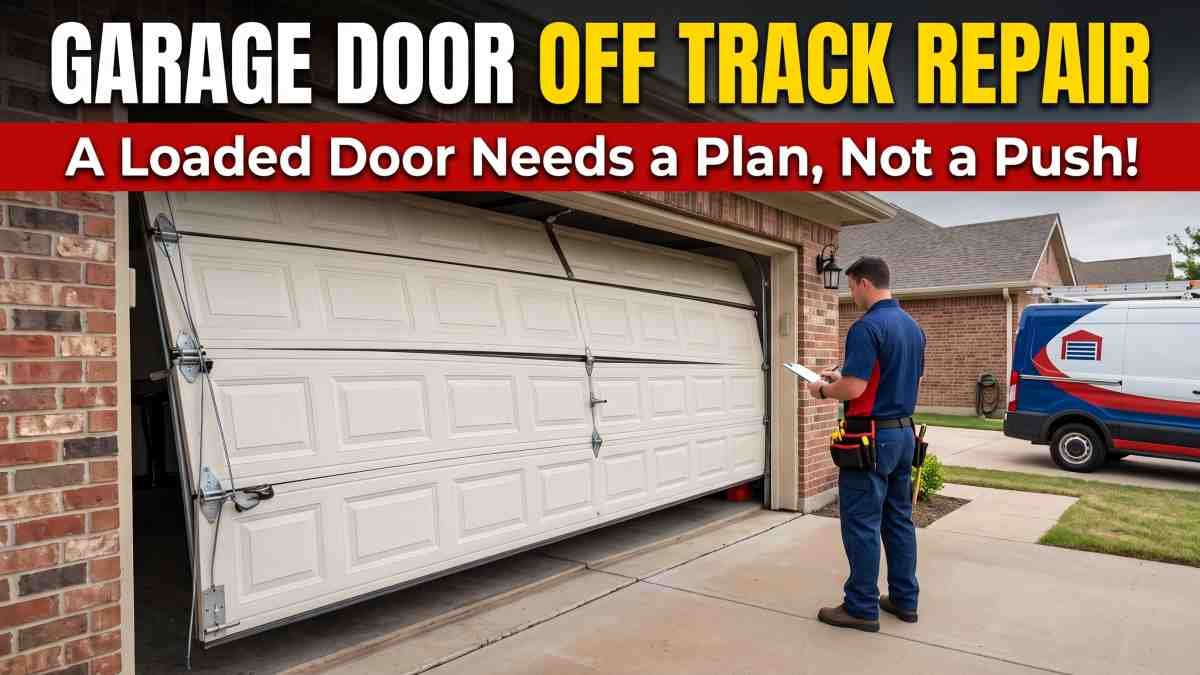
A garage door that jumped its track is not simply stuck. It is a heavy door hanging from springs and cables at the wrong angle. Stop using it, keep people and cars clear, and call a professional. This guide covers garage door off track repair in Dallas: the signs, the safe steps, the cost factors and who to ask.
A door that left its track is still holding spring and cable tension
The tracks are only one part of the system, and that is why an off-track door is dangerous. A sectional door rides on rollers inside the track. Lift cables run from the bottom brackets to the spring system, and the springs carry most of the door’s weight.
According to the Door and Access Systems Manufacturers Association (DASMA), the bottom brackets are tied to the springs and sit under extreme tension. Only a trained door technician should adjust or loosen them. When a roller or cable lets go, the door can sag, twist or drop while that tension is still there.
This page covers residential sectional doors. Commercial doors, rolling doors and gates are a different job.
Six signs the door has left, or is leaving, its track

You can usually spot the problem from the driveway. Look before you touch anything.
Crooked or lopsided door
One side of the door sits lower than the other, or a section looks tilted in the opening. That often means a lift cable slipped off its drum or a roller is out of the track on one side.
A roller hanging out of the rail, or a gap at the track
Each roller should sit snug inside the track. If you can see a wheel outside the rail, or daylight between the roller and the track, the door is no longer guided where it should be.
Grinding or scraping noise
A smooth door rolls quietly. Metal scraping on metal usually means a roller is worn, a roller has popped out, or the track is bent where the door brushes it.
The motor runs, but the door won’t move or won’t close
This looks like an opener problem, and often it isn’t. A door jammed in a bent track, or one with a broken spring, can stall a perfectly good opener. If the door stops partway down and won’t finish closing, a binding track is a likely suspect.
The door stops halfway or reverses on the way down
An opener is built to reverse when the door meets resistance. A door that binds in a bent track can trigger that reversal, so a stop-and-reverse pattern can come from the door rather than the opener.
Bent track or loose wall brackets
Look for a kink, a bowed section, or brackets pulling away from the wall or ceiling framing. A bent track will push the door off again even if someone sets it back.
Need a diagnosis? Call, describe the problem, and ask for a written quote before work starts.
Dallas Garage Door Fix is a homeowner resource that connects you with a participating local garage door company. We don’t perform the repairs ourselves, and we may receive a referral fee from participating companies. Response times and prices are set by the company that takes your call.
What knocks a door off its track in Dallas homes
A hit, a worn part, a slipped cable or a loose bracket accounts for most derailments. Here is how each one happens.
A bump, or storm debris during severe-weather season
A bumper tap to the lower panel is enough to push a roller out of the rail. Debris can do the same. North Texas severe-weather season runs from mid-March through June, according to Harold Brooks of NOAA’s National Severe Storms Laboratory, quoted by the Fort Worth Star-Telegram.
Worn or broken rollers
Rollers wear and crack with use. When one fails, that corner of the door sags and can slip out of the track.
A lift cable that slipped off its drum
On a torsion-spring door, each cable winds onto a drum at the end of the spring shaft. If a cable goes slack, it can jump the drum and one side of the door drops. Cable work involves spring tension, so it belongs with a trained technician.
Loose track brackets on older homes
Dallas’s median home was built in 1981, reported by Point2Homes using Census data. If the original door and hardware are still there, they have decades of cycles behind them, and vibration loosens brackets over time.
What about Dallas clay soil?
Dallas–Fort Worth sits on shrink-swell clay, and the Dallas County Master Gardeners, citing Texas A&M AgriLife, link soil movement to cracks and sticking doors inside houses. That source does not tie it to bent garage tracks. If the wall or slab around your opening looks visibly shifted, tell the company when you call.
DIY or professional? What’s safe to do before anyone arrives, and what to leave alone
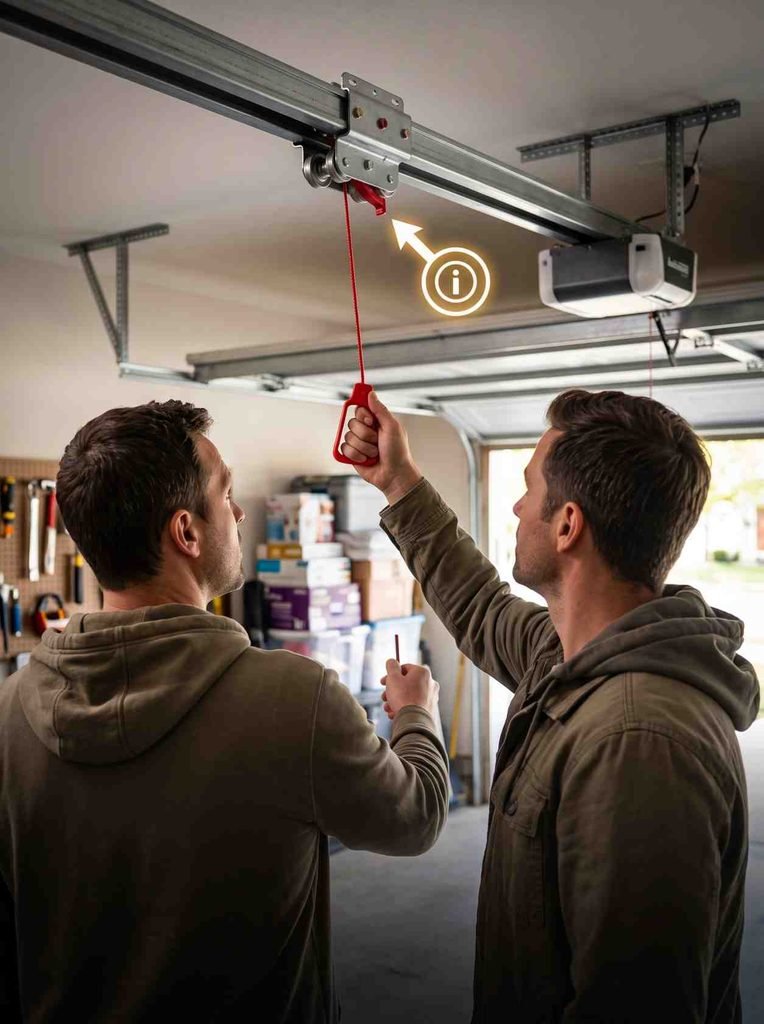
No, do not push the door back onto the track yourself. The door may still be under spring tension, and the cables can be loaded even when the door looks slack.
What you can safely do:
- Stop using the opener and the wall button.
- Keep children, pets and cars away from the door.
- Photograph the damage and note which side sits lower.
- Write down what you heard or saw when it happened.
What to leave alone:
- Forcing the door, or standing under a partly open one.
- The bottom brackets, springs and cables.
- Torsion springs, which are wound with winding bars and are not a home project.
- On older extension-spring doors, anything near the springs. DASMA says extension springs need a safety cable through them, and that cable is only a backup.
Running the opener on a crooked door makes the motor pull against a binding door. That can strain the opener and make the damage worse. If the door sits straight in its track and only the motor or remote acts up, that points to the opener, and our guide to garage door opener repair in Dallas covers that side.
The Door and Access Systems Manufacturers Association (DASMA) says the bottom brackets on a garage door sit under extreme spring tension and should be adjusted or loosened only by a trained door technician, and that spring systems should be repaired only by trained professionals. Their garage door safety tips are worth a read before you reach for a hammer or a pry bar.
What a repair visit looks like, step by step

A proper garage door off track repair in Dallas follows a set order. Here is what to expect from a company.
- Secure the door. The technician locks it in place so it can’t drop or shift while they work.
- Find the root cause. Worn rollers, a bent track, loose brackets, a slipped cable or an impact all cause derailments. Fixing only the symptom brings the problem back.
- Re-seat or replace rollers. Worn or broken rollers come out and the door goes back into the track.
- Straighten or replace the damaged track section. Loose wall and ceiling brackets get tightened.
- Check cables, drums, hinges and balance. A door that jumped once will jump again if one of these parts is worn.
- Reconnect, cycle and test. The door runs through several cycles and the reversal test is repeated before the technician leaves.
What moves the price of an off-track repair
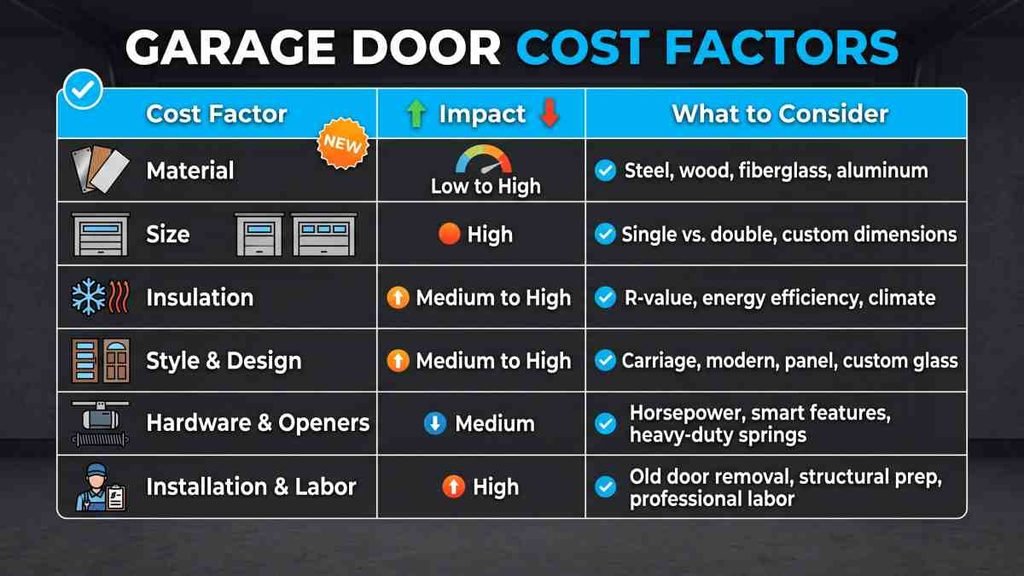
The cause of the derailment and the parts it damaged set the price. Two jobs that look alike from the driveway can cost very different amounts.
| Factor | Why it moves the quote |
|---|---|
| Root cause | A single popped roller is a different job from a slipped cable or an impact |
| Track condition | A track that only popped out may re-seat; a kinked track needs a new section |
| Number of worn rollers | Several worn rollers usually get replaced together |
| Cable and spring condition | A frayed cable or weak spring adds parts and labor |
| Door size and weight | Larger and heavier doors take more work |
| Access and timing | After-hours calls and hard-to-reach tracks can change the quote |
Note: This table lists cost factors, not prices. We don’t publish figures we can’t source. Ask for a written quote that lists parts and labor before work starts.
Single, double and insulated doors
A single-car door is lighter than a two-car door, and an insulated or glass-panel door can weigh more than a plain steel one. More weight puts more strain on rollers, tracks and cables, so a heavier door can mean more parts to inspect. For the wider picture of repair pricing, see our garage door repair cost guide for Dallas.
Re-track, replace a track section, or replace the door?
Most off-track doors need less than a new door, but that depends on what got damaged. This table shows the usual outcome for each situation.
| Situation | Usual outcome | Ask for a second opinion when |
|---|---|---|
| A roller popped out; track looks straight | Re-seat the roller, replace if worn | The roller keeps popping out |
| Track slightly bent | Straighten and re-secure | The bend returns |
| Track kinked or torn | Replace the track section | The quote replaces the whole door without explaining why |
| Panels crushed or twisted | Replace the damaged panel or section | Several panels are damaged |
| A broken spring or cable plus derailment | Repair both | The company skips the spring inspection |
Note: These are typical outcomes, not guarantees. Your door’s age and condition decide the real answer.
If a broken torsion spring caused or came with the derailment, our page on garage door spring repair in Dallas explains that side.
Door stuck crooked or open: emergency visit or scheduled appointment?
Treat it as an emergency if a car is trapped, the door can’t close and the house is exposed, or the door could fall. Otherwise, a scheduled visit is usually fine.
Call for an emergency visit if:
- A vehicle is stuck in the garage.
- The door is stuck open and the interior door to your house is unlocked.
- A section hangs loose or the door looks like it could drop.
A scheduled visit is usually fine if:
- The door is closed, secured and straight enough to leave alone.
- Nobody needs to get a car in or out.
Our page on emergency garage door repair in Dallas covers urgent situations. We can’t promise arrival times. Response times and prices are set by the company that takes your call.
Stuck door right now? Call, describe the problem, and ask for a written quote before work starts.
Dallas Garage Door Fix is a homeowner resource that connects you with a participating local garage door company. We don’t perform the repairs ourselves, and we may receive a referral fee from participating companies. Response times and prices are set by the company that takes your call.
What the safety rules say about a door that won’t run straight
Federal rules cover how an opener and its door work together. Residential openers made on or after January 1, 1991 had to meet UL 325 entrapment protection, according to the U.S. Consumer Product Safety Commission (CPSC). From January 1, 1993, they also needed a secondary device such as a photo-eye sensor, an edge sensor or a hold-to-close wall control.
The opener must reverse within two seconds of hitting an obstruction. That reversal test matters after any repair. Opener instructions also tell owners to keep the door properly balanced and to have a qualified person handle cable and spring work.
Federal rules also shape how a door and opener are supposed to work together. The U.S. Consumer Product Safety Commission’s standard for residential openers, 16 CFR Part 1211, covers openers made on or after January 1, 1993, requires the door to reverse when it meets an obstruction, and tells owners to keep the door properly balanced and to have a qualified service person repair cables, spring assemblies and other hardware.
On paperwork: Dallas Building Inspection’s permit guide says its list of permit exemptions applies outside certain historic, conservation or planned-development districts. If you live in one, or have an HOA, check with your HOA or the City before changing how the door looks.
Seven things to ask before a technician touches the door
Ask these questions before anyone starts work.
- Will I get a written quote with parts and labor before work starts? It stops surprises after the work begins.
- What’s included in the price? You can then compare two quotes fairly.
- Can you show proof of insurance? If the door falls or the house is damaged, it matters who pays.
- Who is actually coming, and is the company local or a national dispatch? It tells you who is accountable and how reachable they’ll be afterward.
- Is there a written warranty on parts and labor? It tells you what is covered if the door comes off again.
- What caused the derailment? A technician who can name the cause is more likely to fix it.
- Will you run the reversal test before you leave? It confirms the door still protects people and pets.
A note on licenses. Texas doesn’t issue a general state contractor license, according to Levelset’s Texas licensing guide. Texas DPS also says garage door opener installers need no DPS license unless the operator connects to an alarm or logs entry and exit. A “license number” on a van doesn’t prove skill, so ask for proof of insurance.
What to photograph and say on the call. Photograph the roller gap, any bent section, both cables at the drums, the bottom corners, and any broken spring. Tell the company which side sits lower, what you heard, and what happened right before it jumped.
How the setting changes the visit: Park Cities, Lakewood and Oak Cliff
Your address can change what rules apply, and it’s worth asking before work starts.
| Area | What’s real | What to ask |
|---|---|---|
| Park Cities | Highland Park and University Park are separate municipalities surrounded by Dallas (SAH Archipedia) | Which city’s rules apply to my address? |
| Lakewood | The City designated the pre-war part of Lakewood Country Club Estates a Conservation District in 1987 (Lakewood Advocate) | Do conservation-district rules affect any change to the door’s look? |
| Oak Cliff | A Dallas real estate site lists Lake Cliff as a historic district and Kessler Park as a conservation district | Does my street fall inside one of them? |
Note: This is context, not legal advice. Confirm with your HOA or the City for your own street.
Frequently asked questions
No. The door is heavy and may still be under spring tension, and the cables can be loaded even when it looks slack. Forcing it can bend panels, snap cables or injure you. Leave it where it is and call a professional.
No. The opener keeps pulling against a binding door, which can strain the motor and drive hardware and make the damage worse. Stop using the wall button and remote until a technician has looked at it. If you can’t leave the door like that, call for help.
Worn rollers, a bent track, loose brackets, a slipped lift cable or an impact are the usual causes. A bumper tap or storm debris can push a roller out. A technician should name the cause so it doesn’t happen again.
No. Federal opener instructions say to use it with the door closed if possible, because weak or broken springs can let an open door fall fast. A crooked or partly open door is exactly the wrong time. Call a professional instead.
It is if a car is trapped, the door can’t close and the house is exposed, or the door could fall. Otherwise a scheduled visit is usually fine. Secure the area and keep everyone clear either way.
A slightly bent track can often be straightened and secured. A kinked or torn track usually needs a new section, because a damaged rail can push the door off again. A technician should show you the damage before you approve anything.
The root cause, the condition of the track, the number of worn rollers, cable and spring condition, door size and weight, and access all matter. We don’t publish prices we can’t source. Always ask for a written quote with parts and labor before work starts.
It depends on what caused it and what got damaged. A single roller is a different job from a bent track plus a slipped cable. Ask the company for a time window when you call, because we can’t promise one.
Yes. A slipped or frayed lift cable can drop one side of the door, and a broken spring changes how the door is balanced. Both involve high tension, so they belong with a trained technician. Tell the company about any broken spring or cable when you call.
It might be. A door jammed in a bent track, or one with a broken spring, can stall a working opener. If the door looks crooked or you see a roller out of the track, stop using the opener and call a professional.
Ask for a written quote with parts and labor, proof of insurance and a written warranty. Ask who will actually come to the house and what caused the derailment. A company that answers clearly is a better sign than a license number.
Texas doesn’t issue a general state contractor license, according to Levelset’s Texas licensing guide. Texas DPS also says garage door opener installers need no DPS license unless the operator connects to an alarm or logs entry and exit. So ask for proof of insurance and a written quote instead.
They can. Highland Park and University Park are separate municipalities, and Dallas has historic and conservation districts with their own rules. Check with your HOA or the City before changing how the door looks. Repairs that don’t change its appearance are a different question from replacements.
Whatever the cause, a door off its track needs a plan. Describe what you see to a participating company, get a written quote, and ask about the reversal test. You can also start from the Dallas Garage Door Fix homepage.
Ready to talk to someone? Call, describe the problem, and ask for a written quote before work starts.
Dallas Garage Door Fix is a homeowner resource that connects you with a participating local garage door company. We don’t perform the repairs ourselves, and we may receive a referral fee from participating companies. Response times and prices are set by the company that takes your call.