
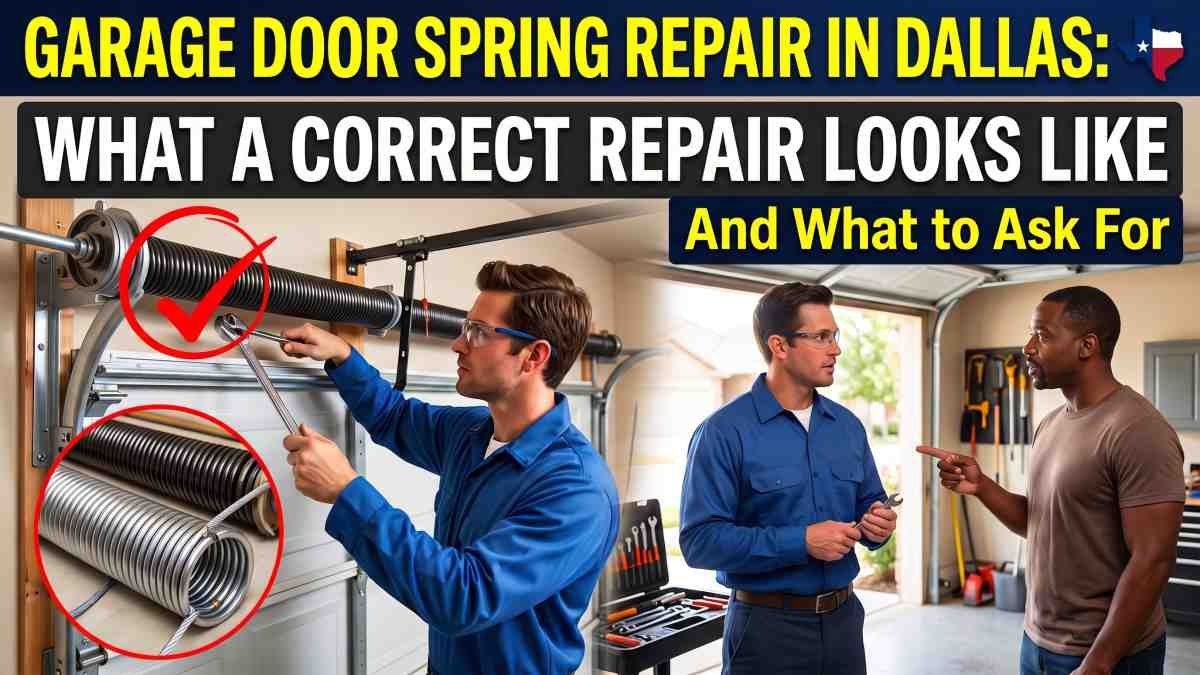
When a garage door spring breaks, the door loses the part that carries its weight. The opener cannot make up the difference. The door stays shut, hangs crooked or feels very heavy. The garage door spring repair Dallas homeowners need starts with three steps: stop using the opener, keep clear of the door, and call a company.
Dallas Garage Door Fix is a homeowner resource and referral service, not a repair company, so this page helps you ask better questions. You will learn how to confirm the spring broke, what is safe to do tonight, how a correct replacement works, and what to get in writing before anyone starts.
Five Signs the Spring Is What Broke (You Can Check From the Floor)
A broken garage door spring usually shows up as a loud bang, a visible gap in the coil above the door, a door that lifts only a few inches, or a door that stays shut while the opener runs. You can confirm most of these from the floor without touching anything. Look, do not reach.
What You Hear and See
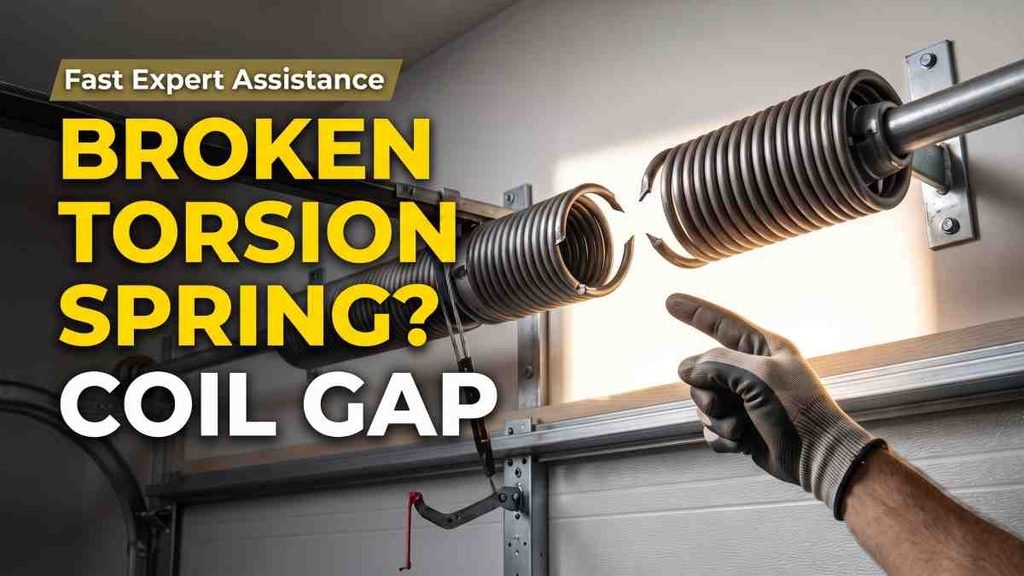
- A sharp bang from the garage, sometimes long before you notice the door is stuck.
- A gap in the coil of the torsion spring on the shaft above the door.
- A door that stays shut while the opener hums.
A quick garage door spring gap inspection from the floor is enough. Do not touch the spring, and do not stand under a raised door.
What the Opener Does
A broken spring leaves the opener to lift the whole door. Chain, belt and screw-drive openers are all built to guide a balanced door, not carry a full one. You may hear the motor strain, see the door rise a few inches and stop, or watch it lift crooked, with one side higher than the other.
Spring, Cable or Opener?
A snapped lift cable, a door off its track or a dead opener can look like a broken spring. A gap in a torsion spring coil points to the spring. If the spring looks whole and the door hangs crooked, check the bottom corners for a frayed or loose cable, and tell the company what you see.
A door that will not close can also be a sensor problem, so check the photo-eye sensors near the floor.
Torsion vs Extension Springs: What Each One Does to Your Door
A torsion spring mounts on a shaft above the door and twists to lift it through cables and drums. An extension spring runs along each horizontal track and stretches to do the same job. Which one your door has depends on how it was built.
Torsion Springs: Shaft, Cones and Drums
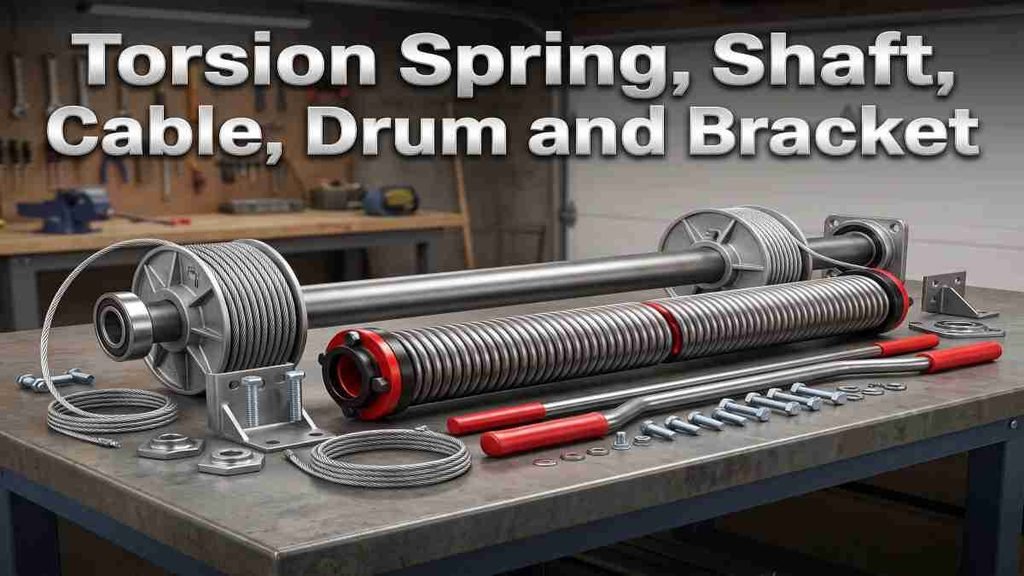
A torsion spring sits on a steel shaft and stores force as it winds. Winding cones hold its ends, and a cable drum at each end of the shaft winds the lift cable. When the spring breaks, nothing carries the door’s weight, so the fix is a new spring, plus a look at the parts around it.
Extension Springs and Safety Cables
An extension spring runs beside each horizontal track and stretches as the door closes. The Door & Access Systems Manufacturers Association (DASMA) says an extension spring needs a safety cable that runs through it and secures to the wall or ceiling at each end, so a broken spring stays contained. If your door has extension springs and no safety cable, DASMA tells homeowners to call a dealer for a safety inspection, and you can ask about extension spring safety cable replacement during the same visit.
How to Tell Which One You Have
Stand inside the garage with the door closed. A thick coil on a bar above the door is a torsion spring, and long springs beside the side tracks are extension springs. Describe what you see when you call, and let the company confirm the spring type before it quotes.
Springs Wear Out by Cycles, Not Years
A garage door spring wears out by cycles, not calendar years. One cycle is one full open and one full close. Contractors such as Plano Overhead Garage Door describe 10,000 cycles as the standard rating for a residential torsion spring, so a busy door can use up a spring much sooner than a quiet one.
What a Cycle Rating Means
DASMA’s technical data sheet on spring cycle life says handling, installation and daily use all affect how long a spring lasts. It also notes that spring cycle life does not always match door cycle life, so a sound door can still need new springs. Suppliers sell high-cycle springs with ratings such as 25,000 or 30,000 cycles, and a standard spring is rated at about 10,000.
What the Cycle Math Looks Like
Divide the rating by your yearly openings to see roughly how long a spring lasts. Four openings a day adds up to about 1,460 cycles a year.
| Openings per day | 10,000-cycle spring | 25,000-cycle spring |
|---|---|---|
| 2 | about 13.7 years | about 34 years |
| 4 | about 6.8 years | about 17 years |
| 6 | about 4.6 years | about 11.4 years |
| 8 | about 3.4 years | about 8.6 years |
Note: This is simple arithmetic, not a prediction. One cycle is one open and one close, and real spring life varies with installation, handling and use, as DASMA’s data sheet explains.
Dallas Heat: What the Weather Service Shows
The National Weather Service in Fort Worth reports that the first 100-degree day at DFW arrives around July 1 on average and the last around August 27. Its records also show 55 days at 100 degrees or higher in 2023 and a record of 71 in 2011. No manufacturer or standards body we found says how much heat shortens a spring’s life, so treat any percentage on a company’s page as that company’s opinion.
What you can control is maintenance. DASMA recommends an annual visit from a trained door systems technician, and it advises having older springs inspected and replaced if needed. For a squeaky spring, DASMA suggests a spray lubricant made for garage doors before you call.
After a Spring Breaks: What Is Safe, What Isn’t, and What to Do Tonight
After a spring breaks, stop using the opener, keep people and pets clear, and do not try to lift the door by hand. Look at the spring from the floor, take photos, and note the door size. Then call a garage door company and ask when it can send a technician.
What Is Safe for You to Do
- Stop using the opener. DASMA warns that an out-of-balance spring system causes extra wear on other door parts.
- Keep children, pets and people clear of the door.
- Leave the emergency release alone unless a technician tells you to use it.
- Photograph the spring and the gap, and note whether the door is one-car or two-car.
Professional-Only Work
Winding or unwinding a spring, loosening the winding cones, adjusting the bottom brackets and replacing lift cables are all technician jobs.
The Door & Access Systems Manufacturers Association (DASMA) says spring systems should be repaired only by trained professionals. Its safety tips add that the bottom brackets are under extreme tension and should be adjusted only by a trained door systems technician, and that frayed lift cables should be replaced only by one. Read the full list on the DASMA garage door safety tips page.
Is It Safe to Lift the Door by Hand With a Broken Spring?
No. Without the spring, the full weight of the door lands on you, and the Consumer Product Safety Commission warns that a severely unbalanced door can crash down on anyone beneath it. If a car is trapped inside, tell the company when you call. Our emergency garage door repair page explains what to ask.
After Hours and a Trapped Car
Some Dallas companies offer emergency garage door spring repair at night or on weekends, and others book the next business day. This site cannot send a technician or promise a time, so ask one direct question: will someone come tonight, or tomorrow morning? Ask whether an after-hours charge applies.
Spring Repair or Replacement? One Spring or Both?
A broken garage door spring is replaced, not repaired. If your door has two springs, the Door & Access Systems Manufacturers Association advises replacing both, even if only one broke. The second spring has the same age and the same use, and its break can damage the door.
Broken Springs Are Replaced, Not Repaired
Spring steel that has cracked cannot be welded or stretched back into service. On a torsion system, the new spring has to match your door, which the checklist further down explains. Companies call the job spring repair, but the work is a replacement.
One Spring or Two?
Count the springs above your door. One spring means one replacement, and two mean a pair, so ask whether the quote covers both. A single spring replacement and a double spring replacement are different jobs, and a larger two-car door is heavier, so ask the company to size the springs to your door.
Spring, Cable or Opener Repair?
If the spring failed, the repair is a spring replacement. If a lift cable is frayed, the repair is a cable replacement, which DASMA says only a trained technician should do. If the opener is the problem, the spring may be fine, so ask the company to test the door’s balance before it blames the opener.
One failed spring is a part, not a reason to replace the door. Several damaged sections or repeated failures are a different conversation.
How a Correct Spring Replacement Works, Step by Step
A correct spring replacement has five parts: the technician measures your door and spring, makes the door safe, removes the old spring, installs and winds the new one, then tests balance and the opener’s reverse. Time varies by door, and companies quote their own, so ask yours.
Measure and Match
The technician works out your door’s weight and reads the old spring’s size, and the checklist in the next section shows the numbers to ask for. DASMA’s data sheet lists a spring on the wrong door, the wrong number of turns and winding a spring backwards among the factors that cut spring life. A correct job starts with matching, not guessing.
Unwind, Remove, Install and Wind

With the door secured, the technician unwinds the old spring in small controlled turns with winding bars, removes it, fits the new spring and winds it to the turn count the door calls for. Garage door spring installation safety procedures exist because a wound torsion spring stores force that can injure whoever is holding the bar. This is why DASMA calls for trained technicians on spring work.
Balance Test and Reverse Test
Once the spring is in, the technician checks that the door stays put when stopped partway up. Then the opener’s travel limits and force settings are reset, and the photo-eye sensors and auto-reverse are tested. That manual balance check is for a working door, not one with a broken spring.
The U.S. Consumer Product Safety Commission says a properly balanced door stays in place when you stop it partway open. It also explains how to test an opener’s reverse function: lay a 2×4 flat on the floor in the door’s path, and if the door does not reverse when it touches the board, stop using the opener until it is adjusted, repaired or replaced. See the CPSC garage door opener safety sheet.
Cables, Drums and Bearings Checked
Lift cables, cable drums and the center bearing carry the same load as the spring, so ask whether the technician inspected them. Professional Garage Concepts, a DFW contractor, reports 60 to 90 minutes for a typical torsion spring job, and other companies quote their own times. Ask yours how long the visit will take and what it includes.
The Spring Spec to Ask For Before You Approve a Quote
Before you approve a quote, ask for the spring spec in writing: wire size, inside diameter, length, wind direction, cycle rating and how many springs. A company that sized the spring to your door will have these numbers. A company that guessed will not.
- Wire size, inside diameter and length. These set the spring’s torque and lifting force, and a near match can leave the door out of balance.
- Wind direction, left or right. Left-wound and right-wound springs are not interchangeable.
- Cycle rating. It tells you how many openings to expect before the spring wears out.
- One spring or two. DASMA advises replacing both on a two-spring door.
- The door weight used for sizing. DASMA’s data sheet lists a spring on the wrong door among the factors that shorten spring life.
- Cables, drums and bearings. Ask whether they were inspected or replaced, since they carry the same load.
- Warranty in writing. Ask what it covers, parts, labor or both, and for how long.
- Written total. It should list parts and labor before work starts.
Door Weight and Material
Steel, insulated, wood and glass-panel doors weigh different amounts, and an oversized or heavy double door needs springs sized for that load. Tell the company the material, any insulation or glass, and whether it is a one-car or two-car door. If your door is older, say so.
What Affects Garage Door Spring Replacement Cost in Dallas?
Garage door spring replacement cost in Dallas depends on how many springs the door needs, the door’s size and weight, the cycle rating, any extra parts such as cables or bearings, and the time of the call. Published price ranges vary widely, so compare written quotes line by line.
- One spring or two. A pair costs more than a single, so ask whether the quote covers both.
- Door size and weight. Larger steel, insulated, wood or glass-panel doors need stronger springs, so the quote can rise.
- Cycle rating. Higher-cycle springs use heavier wire, so ask what the upgrade adds.
- Extra parts. Cables, drums, bearings and rollers add to the total, so ask which are included.
- Time of call. After-hours and weekend calls may carry a surcharge, so ask before you agree.
- Parts availability. If a spring must be ordered, the job can take longer.
A garage door spring repair estimate over the phone is a starting point. The garage door spring replacement quote you approve should be in writing, with parts and labor listed before work starts. For more on pricing, see our garage door spring replacement cost guide.
How to Choose a Spring Repair Company in Dallas
Choose a spring repair company that gives a written quote, shows proof of insurance, names the spring spec, and explains the warranty in writing. Be careful with prices far below everyone else’s and with any technician who pushes a full door replacement for one broken spring.
- A written quote that lists parts and labor. It stops the price from changing at your door.
- Proof of insurance. Ask for a certificate, because it tells you who is responsible if the door or a technician is hurt.
- The spring spec on the quote. It shows the spring was sized to your door.
- A warranty in writing. Parts and labor can be covered differently, so get both in writing.
- An explanation of what failed. Ask the technician to show you the broken spring.
Searching for garage door spring repair near me Dallas turns up plenty of names, so use these questions to compare them. Affordable should mean a clear written quote, not the lowest number on the phone. If a company says its technician is licensed, ask to see proof.
Red flags
- A price far below every other quote. Risk: a low-cycle or mismatched spring that wears out early.
- No written quote or spring spec until work starts. Risk: the price rises once the door is apart.
- A new door pushed for one broken spring. Risk: you pay for a door you do not need.
Dallas Neighborhoods and Nearby Areas Where This Applies
A broken spring works the same way in Lakewood, Oak Lawn, Uptown, Deep Ellum, North Dallas or East Dallas, and in the Highland Park and University Park areas. What changes is your door: its size, weight, spring type and the company’s schedule that day. Wherever you are near downtown or in any Dallas ZIP code, garage door spring repair Dallas companies need the same details from you, so describe the door and the spring and ask for the spec in writing.
Garage Door Spring Repair in Dallas: FAQs
Look for a sharp bang, a gap in the coil above the door, a door that stays shut or lifts only a few inches, or a door that hangs crooked. Check from the floor and do not touch the spring. A crooked door can also point to a cable or track problem, so describe what you see when you call.
No. Without the spring, the full weight of the door falls on you or on an opener built to guide a balanced door. DASMA warns that an out-of-balance spring system wears other door parts, and the Consumer Product Safety Commission warns that a badly unbalanced door can crash down. Stop using the door until a technician replaces the spring.
If your door has two springs, DASMA advises replacing both, even if only one has broken. The second spring has the same age and the same use as the first. Replacing it now prevents damage if it breaks later and keeps the door working efficiently, according to DASMA.
A broken spring is replaced. Once the coil has cracked apart, it cannot be welded or stretched back into service. Companies call the job spring repair, but the work is a spring replacement.
Springs wear out by cycles. Contractors such as Plano Overhead Garage Door describe 10,000 cycles as the standard rating, and DASMA says handling, installation and daily use all affect how long a spring lasts. Heat is a Dallas factor, but no manufacturer or standards body we found says how much it shortens spring life.
They can be if your door opens many times a day, because a higher rating means more cycles before the spring wears out. High-cycle springs use heavier wire and may be longer, so the company must confirm your headroom and that the spring still balances your door. Compare the cycle rating on each written quote.
Hire a professional. DASMA says spring systems should be repaired only by trained professionals, and the bottom brackets and lift cables are technician jobs too. A wound torsion spring stores force that can injure you, and a spring that is close but not correct can leave the door out of balance.
Professional Garage Concepts, a DFW contractor, reports 60 to 90 minutes for a typical torsion spring job, and other companies quote their own times. A complete visit includes measuring the door and spring, replacing the spring, checking cables, drums and bearings, balancing the door and testing the opener’s reverse. Ask the company to list what its visit includes.
Warranties vary by company, so ask before you approve the work. Ask what the warranty covers, whether it includes parts, labor or both, and how long it lasts. Get the answer in writing on the quote.
Some Dallas garage door companies advertise after-hours service, but this site cannot send a technician or promise a time. Availability depends on each company’s schedule that day. When you call, ask whether a technician can come tonight or tomorrow morning, and whether an after-hours charge applies.
Look for a written quote that lists parts and labor, proof of insurance, the spring spec on the quote and a written warranty. Be careful with prices far below the rest and with a technician who pushes a new door for one broken spring. If a company says it is licensed, ask to see proof.
Yes. The Consumer Product Safety Commission says to test an opener’s reverse function by laying a 2×4 on the floor in the door’s path. If the door does not reverse when it touches the board, stop using the opener until it is adjusted, repaired or replaced. Ask the technician to test it before leaving, and repeat the test yourself.
Conclusion
Call a garage door company, describe the spring and the door, and ask for the spring spec and a written quote before work starts. Mention whether you see one spring or two, the door size, and what you heard or saw when it broke. That is the simplest way to get garage door spring repair Dallas homeowners can check for themselves.
Dallas Garage Door Fix is a homeowner resource and referral service, not a garage door contractor. Your call may be answered by a participating local garage door company or by a service that connects callers with one, and we may be compensated for referred calls. Prices, availability and warranties are set by the company you speak with.