
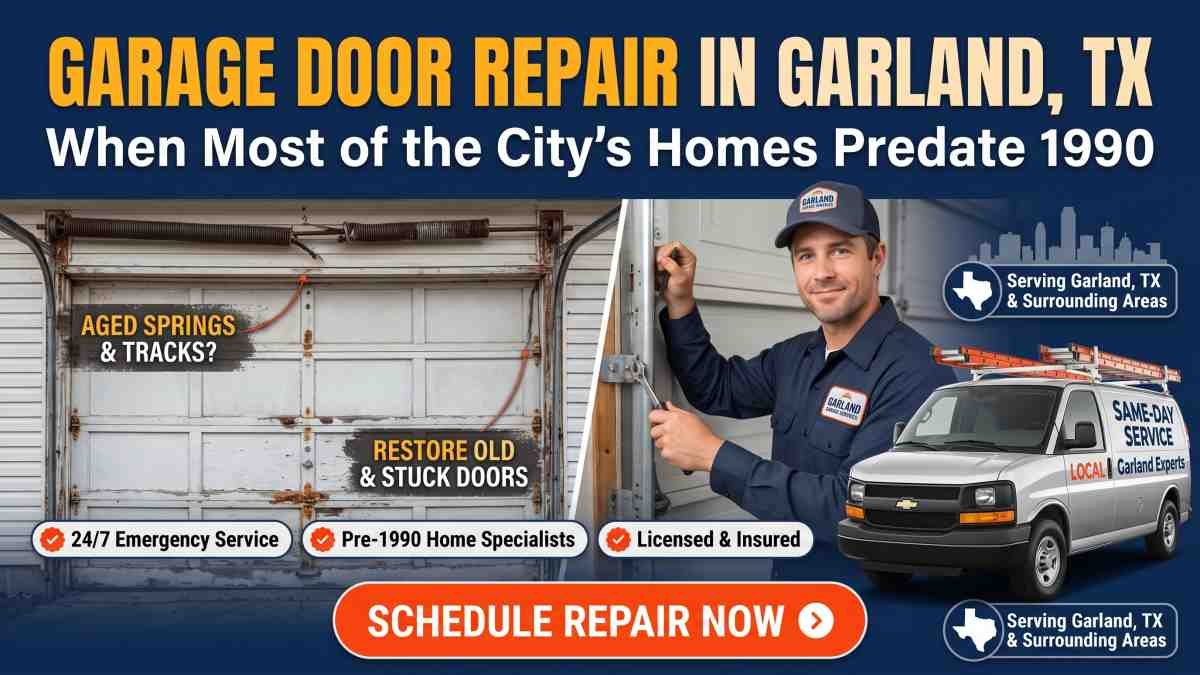
Most Garland garage doors have years of daily use behind them, so wear is the first suspect when one fails. A broken spring, frayed cable or misaligned sensor sits behind many failures, and only some are safe to touch. This page covers garage door repair Garland TX homeowners can check themselves and what belongs to a technician.
Dallas Garage Door Fix is a homeowner resource that connects you with a participating local garage door company. We don’t perform repairs ourselves, and nothing on this page is a quote.
Three in Four Garland Homes Were Built Before 1990: What That Means at the Garage Door
Point2Homes reports that about 74% of Garland homes were built before 1990, so many original doors have decades of daily cycles behind them. That wear shows up in springs, cables and rollers long before a door looks old. Age alone doesn’t mean replacement, but it shapes what a technician will find.
The 74% is our sum of Point2Homes’ decade shares from before 1950 through the 1980s, and the site reports a median year built of 1978.
Wikipedia’s census table shows how fast the city grew: 10,571 residents in 1950, 38,501 in 1960 and 81,437 in 1970. Garage door repair Garland TX owners face on older houses usually starts with springs, cables and rollers, not the opener. Neighboring Mesquite has a similar profile, with about 69% of homes built before 1990 (Point2Homes, our sum), and our Mesquite garage door repair page adds hail and heat detail.
If you rent (Point2Homes reports 38.4% of Garland’s occupied homes are renter-occupied), tell your landlord or property manager about a failing door in writing before you arrange any work. This page covers residential doors, not commercial or warehouse ones.
Reading the Symptoms: What Each Fault Usually Points To
A door that won’t move, stops halfway, reverses or grinds is usually telling you which part failed. Won’t open often means a broken spring, a locked latch or a dead remote battery. Stopping halfway or reversing usually points to track, cable or sensor trouble.
Won’t open or won’t close
Check remote batteries, the wall button’s lock setting and the opener’s power first. If the opener runs but the door barely moves, a spring has likely broken. A door that won’t close usually has a blocked or dirty photo-eye sensor.
Stuck halfway
A door that stops halfway usually has a track, roller or cable problem, or an opener whose travel limits have drifted. Our guide on why a garage door won’t open all the way walks through the causes. Don’t force the door past the point where it stalls.
Opens, then reverses
If the door starts down and then reverses, the photo-eye sensors are the usual cause. Wipe both lenses and look for a steady light on each sensor. If it still reverses, a technician should check the force settings.
Grinding, humming or shaking
A humming opener with a motionless door often means a broken spring, not a failed motor, because the opener can’t lift the full weight alone. A noisy door that grinds usually points to dry or worn rollers, loose hinges or a dry track.
Need a diagnosis? Call, describe the problem, and ask for a written quote before work starts.
Dallas Garage Door Fix is a homeowner resource that connects you with a participating local garage door company. We don’t perform the repairs ourselves, and we may receive a referral fee from participating companies. Response times and prices are set by the company that takes your call.
How Years of Daily Cycles Wear Springs, Cables and Rollers
Garage door springs wear out by cycles, not by calendar. Each open and close twists or stretches the spring a little, and its cycle rating tells you roughly how many trips it was built to make. A door used several times a day reaches that number sooner than one used once.
Newer sectional doors usually carry a torsion spring on a bar above the door, while older doors often use extension springs along the horizontal track. Our garage door spring repair in Dallas page covers what a replacement involves.
Lift cables wear where they wind onto the cable drum, and rollers lose their bearings over time. North Texas summer heat can dry out lubricant and harden weather stripping.
Replace a spring when it breaks, shows a gap in the coil or the door feels heavy and slams down. If one spring on a two-spring door has failed, the other has the same number of cycles on it, so technicians often replace both. Never try to tighten or loosen a spring yourself.
Which Parts You Can Touch and Which Belong to a Technician
You can safely check sensors, remote batteries, the lock and visible track debris. Springs, lift cables, cable drums and bottom brackets belong to a trained technician. The Door & Access Systems Manufacturers Association (DASMA) draws that same line because these parts hold enough tension to injure you.
| Part | Safe for you to handle? | Why |
|---|---|---|
| Photo-eye sensors | Yes: wipe and check the lights | No stored tension |
| Torsion or extension springs | No | Highest stored tension on the door |
| Lift cables and cable drums | No | Under spring tension |
| Bottom brackets | No | They hold spring tension |
Note: Springs, cables and bottom brackets follow DASMA’s guidance. If you’re unsure, leave the part alone.
Safe checks
- Replace the batteries in your remote and keypad.
- Wipe both photo-eye lenses and confirm each shows a steady light.
- Clear debris from the tracks, and leave track adjustments to a technician.
Technician-only parts
The Door & Access Systems Manufacturers Association ranks springs “arguably the most important and most dangerous part of your door”. It says cables and the bottom brackets that hold spring tension should be handled only by a trained door systems technician. On a two-spring door, DASMA advises replacing both springs together.
Stuck shut with the car inside
Pulling the emergency release cord disconnects the opener, but it does not fix a broken spring. A door with a broken spring has lost the help that makes it light, so lifting it by hand is how people get hurt.
Stuck door right now? Call, describe the problem, and ask for a written quote before work starts.
Dallas Garage Door Fix is a homeowner resource that connects you with a participating local garage door company. We don’t perform the repairs ourselves, and we may receive a referral fee from participating companies. Response times and prices are set by the company that takes your call.
Storm Damage and Impacts: Fix One Section or Start Over?
A dented or cracked panel can sometimes be replaced alone, but only when the rest of the door is straight and a matching section is available. Hail, a falling branch or a bumped car can crack a panel and bend a track. A technician needs to check both before anyone decides.
Stormersite lists 176 hail reports within 10 miles of Garland since 2004, with the most recent a 1.75-inch report on April 27, 2026. Wikipedia’s account of the December 26, 2015 tornado, an EF4 that crossed southeast Garland and Rowlett, is a reminder that this area’s weather can be severe.
After hail, look for creased panels and cracks along the seams. A bent track can bind the rollers and push the door off track, so stop using the door.
Ask whether a matching section is still available for an older door, because a mismatched panel can turn a one-section fix into a full replacement. If you plan to file an insurance claim, photograph the damage first and ask your insurer what it covers.
From the First Call to the Final Test: How a Repair Unfolds
A repair visit generally runs in this order:
- The technician runs system diagnostics on the sensors, opener, tracks, cables and springs.
- A counterbalance inspection checks whether the springs still offset the door’s weight.
- You receive the findings and a written quote listing parts and labor, then approve or decline.
- After the repair, the technician tests balance, travel limits and auto-reverse.
How long a repair takes depends on the fault and whether parts are on hand, so ask the company for a window instead of assuming one.
What Moves a Garland Repair Quote, and What Doesn’t
A repair quote moves with the failed part, the door’s size and weight, parts availability and the hour you call. Two quotes for the same symptom can still differ a lot. Ask for a written quote that lists parts and labor before any work starts.
| Factor | Tends to raise the quote | Tends to lower it |
|---|---|---|
| Failed part | A pair of springs, or a cable plus drum | A single sensor or cable |
| Door size and type | Two-car, insulated or glass-panel door | One-car, non-insulated steel door |
| Parts for older doors | Hardware that is hard to match | Common parts a company stocks |
| When you call | After-hours or urgent visit | Scheduled daytime visit |
Note: This table shows factors only. We don’t publish prices we can’t source, so ask each company for a written quote.
Any garage door repair Garland TX quote should name the failed part, the replacement part and the labor. Ask whether the service call fee is credited toward the repair. For the wider Dallas picture, see what repairs cost in Dallas.
Garland’s Contractor Registration Rule and What It Means When You Hire
The City of Garland says contractors doing permitted work must be State-licensed and registered with its Building Inspection Department. Its permit page doesn’t say whether garage door repair falls under that rule. Ask the company directly, and call the City to be sure.
Permits
The City’s Building Permit page says: “All new construction/remodels/additions/interior completions/demolition (either in part or whole) require permits.” It doesn’t mention garage doors or any repair exemption, so call City Hall at 972-205-2000 before assuming either way.
Contractor registration
The same page says, “The City of Garland requires those contractors to be registered with the City’s Building Inspection Department,” and adds “No exceptions.” It doesn’t say whether a garage door repair counts as that kind of work. For any garage door repair Garland TX companies quote, ask whether the company is registered with the City and carries insurance.
HOAs and neighborhood associations
If your Garland neighborhood has a homeowners association, we couldn’t verify what it requires for garage doors. A spring or cable swap doesn’t change how a door looks, but a panel or full-door change can. Check your HOA’s rules before you approve anything that alters color or style.
Two Minutes, One Board: Checking Whether Your Door Still Reverses
A working opener reverses when a closing door meets an obstacle, and it stops when the photo-eye beam is blocked. The U.S. Consumer Product Safety Commission required entrapment protection on openers made on or after January 1, 1993. Test both features about once a month.
- Lay a 2×4 board flat on the floor under the door, with people and pets clear.
- Close the door with the wall button. It should reverse as soon as it touches the board.
- Close it again and pass an object through the beam. The door should reverse.
- If either test fails, stop using the automatic close and call a technician.
Photoelectric sensor alignment matters: the sensors sit about 4 to 6 inches above the floor. If the door reverses on a light touch or stops short of the floor, the opener’s force settings and travel limits likely need adjusting. Entrapment protection is also part of UL 325, the safety standard for door operators.
The U.S. Consumer Product Safety Commission’s final rule on automatic openers, issued December 3, 1992, requires openers made on or after January 1, 1993 to include entrapment protection. That means an external sensor such as an electric eye, or a constant-contact control button.
Hiring Checklist: What to Ask, and Why Each Answer Matters
Ask these seven questions on the first call.
- Who will arrive, and which company are they with? Why it matters: a service that connects callers may answer first.
- Is the company registered with the City of Garland? Why it matters: the City’s page doesn’t spell out whether repairs are covered.
- Can you show proof of insurance? Why it matters: damage during a spring job shouldn’t fall on you.
- Will the quote be in writing and list parts and labor? Why it matters: it lets you compare companies line by line.
- Is the service call fee credited toward the repair? Why it matters: it changes what the visit really costs.
- What warranty covers parts and labor, and is it in writing? Why it matters: a warranty is only worth what the paperwork says.
- Will you test balance and auto-reverse before you leave? Why it matters: a door that lifts but doesn’t reverse isn’t finished.
Straight Answers to Common Garland Garage Door Questions
It depends on the failed part, the door and the company. No verified Garland price list exists, so we don’t quote numbers. Ask for a written quote that lists parts and labor.
The City’s Building Permit page lists new construction, remodels, additions, interior completions and demolition. It doesn’t mention garage doors or repair exemptions. Call City Hall at 972-205-2000 to confirm for your job.
The City says contractors doing permitted work must be State-licensed and registered with its Building Inspection Department. It doesn’t say whether a repair counts as that work. Ask the company whether it is registered, and ask for proof.
Possibly, if your neighborhood has an association. Association rules tend to focus on appearance, so a color or style change is likelier to need approval than a spring swap. Check your HOA’s rules before you approve work.
You shouldn’t lift it by hand. A broken spring removes the help that makes the door light, so the full weight lands on you or the opener. If your car is trapped, call a technician.
Spring life is measured in cycles, and each spring has a cycle rating from its maker, so no honest calendar answer exists. A door used more often spends its cycles faster. Replace a spring when it breaks, shows a gap in the coil or the door feels heavy.
It depends on your policy, your deductible and how your policy treats wind and hail. We can’t say what yours covers. Photograph the damage and ask your insurer or agent before repairs begin.
Stopping halfway usually points to a track, roller or cable problem, or to drifted travel limits. Reversing before the floor usually points to dirty or misaligned photo-eye sensors. Clear the beam and wipe the lenses first, then call if it continues.
A hum means the opener’s motor has power. Often the door doesn’t move because a spring has broken, which leaves the opener trying to lift the whole door. Stop pressing the button and call a technician.
Lay a 2×4 flat on the floor and close the door; it should reverse when it touches the board. Then block the photo-eye beam as it closes; it should reverse again. If either test fails, stop using the automatic close.
Sometimes one panel can be replaced, if the rest of the door is straight and a matching section is available. A bent track can sometimes be straightened or replaced. A technician has to look at the whole door.
Before You Pick Up the Phone
Write down what the door does, what you hear and what you’ve already checked: batteries, sensors, the release cord. Whatever the fault, a good garage door repair Garland TX call ends with a written quote that lists parts and labor.
Dallas Garage Door Fix is a homeowner resource, not a repair company, and the participating company that answers sets response times and prices. You can find more plain-language guides at Dallas Garage Door Fix.
Ready to talk to someone? Call, describe the problem, and ask for a written quote before work starts.
Dallas Garage Door Fix is a homeowner resource that connects you with a participating local garage door company. We don’t perform the repairs ourselves, and we may receive a referral fee from participating companies. Response times and prices are set by the company that takes your call.