
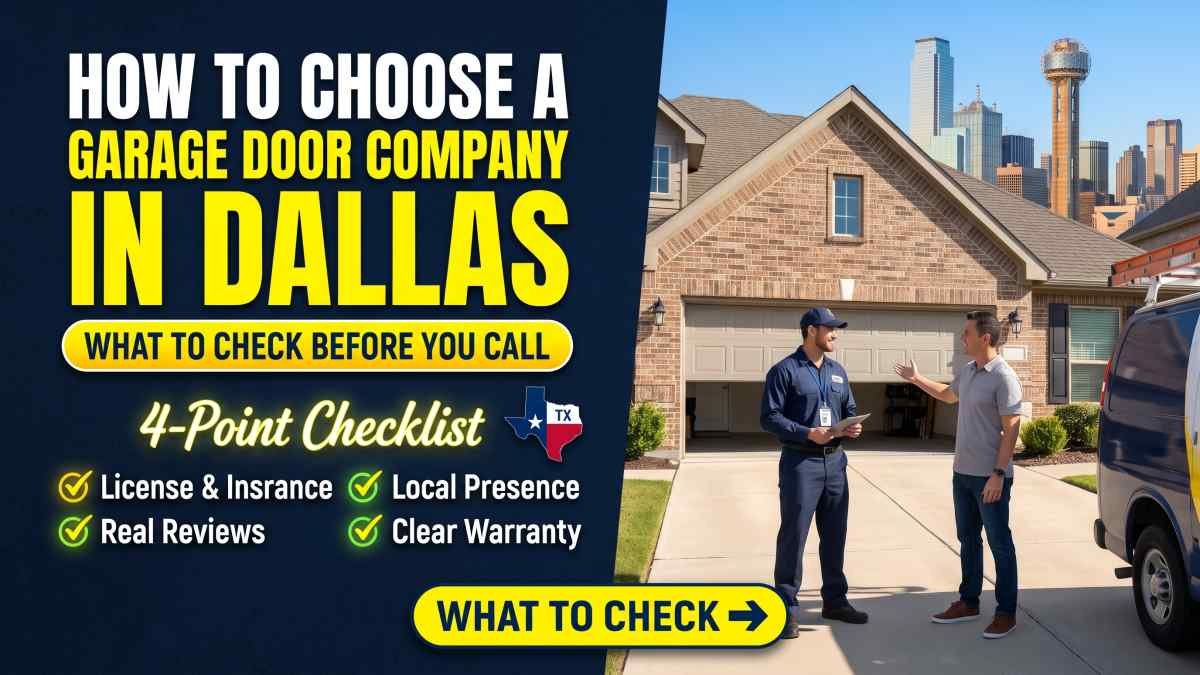
In short: Ask for proof of insurance, a written quote that lists parts and labor, and warranty terms in writing. Find out who will work on your springs and cables. Those checks are how to choose a garage door company in Dallas without leaning on a license number or a star rating.
In Short: The License Question Most Guides Get Wrong
Most guides tell you to hire only a licensed garage door company. For installers who work only on garage door operators and their activation accessories, the Texas Department of Public Safety says no DPS license is required. So a license number tells you less than proof of insurance, a written quote and trained technicians do.
That doesn’t mean anything goes. It means the word “licensed” in an ad shouldn’t end your research. The rest of this guide shows what to check instead, in the order you’ll need it on a real phone call.
What Texas Does and Doesn’t Require
Texas DPS regulates some gate and opener installers under Texas Occupations Code Chapter 1702, but it exempts installers who do only garage door and gate operator work. A DPS license applies when the opener connects to an alarm system or logs who enters and leaves. A basic opener with remotes, a keypad and a wall button isn’t tied to either.
Operator-only installers and the DPS exemption
According to the Texas Department of Public Safety, an installer who does only this work, and no other activity regulated under Chapter 1702, doesn’t need a DPS license. The exemption covers operators for residential and commercial gates, garage doors and upward-acting doors. It also covers accessories used only to activate them, such as push buttons, radio transmitters, keypads and card readers.
DASMA’s legal news reported that DPS halted enforcement of the law against garage door and gate operator installers in late 2004. The Texas Private Security Board also posted a notice that these installers didn’t need a license or registration.
When an alarm or entry-logging link changes that
DPS says a license is required when the operator connects to an alarm system or monitors or logs entry and exit. If your door is wired into a security system, ask the company whether the job touches that connection.
If a company says it’s “state licensed,” ask which license, who issued it and what it covers. Checking credentials in Texas starts with asking, not assuming.
Does a garage door company need insurance in Dallas? We didn’t find a Texas rule that requires it, so make proof of coverage your own requirement.
Five Things Worth Checking Instead
When you’re working out how to choose a garage door company in Dallas, five checks matter more than a license number. Ask for a certificate of insurance, a written estimate, written warranty terms and proof of a trained technician, plus a clear answer on who handles springs and cables. Each takes minutes and shows how the company operates.
- Certificate of insurance. It shows a policy exists and when it ends.
- Written estimate. It fixes the scope and price before work starts.
- Written warranty terms. They tell you what the company fixes if the repair fails.
- A trained technician. DASMA recommends that trained door systems technicians install garage doors.
- Spring and cable handling. These parts carry the door’s weight under tension, so they’re professional-only.
The opener matters too: automatic residential openers made on or after January 1, 1993 must include entrapment protection, such as an external sensor, under rules published by the U.S. Consumer Product Safety Commission. A company that installs or services your opener should be able to test that feature in front of you.
Insurance: What to Ask For, and Why
Ask the company to send a certificate of insurance before the technician arrives. The certificate shows the insurer, the policy dates and the type of coverage. If a worker is hurt or your door or car is damaged during the job, you want to know who pays.
Ask about two kinds of coverage. General liability covers damage to your property, and workers’ compensation relates to injured employees. Then ask whether subcontractors on your job fall under the same policy.
A garage door installer’s liability insurance only counts if it’s active. You can call the insurer named on the certificate to confirm. A company that stalls on sending the certificate has told you something useful.
Why the Technician Matters More Than the Logo
Training matters most on the parts under tension. Springs, lift cables and bottom brackets carry enough force to cause serious injury if handled wrong, which is why they’re professional-only. When you compare companies, ask who will do that work and how they were trained.
DASMA, the Door & Access Systems Manufacturers Association, advises that spring systems should be repaired only by trained professionals and that cables should be replaced only by a trained technician. Its garage door safety tips are worth reading before you speak with any company.
A door that stops lifting after a loud bang is often a spring problem, not an opener problem. Our page on spring repair explains the signs and what a technician checks.
Do not touch: springs, lift cables and bottom brackets
These parts hold or carry the door’s weight under high tension. DASMA says only trained professionals should handle them, because a slip can cause serious injury.
Not sure what is wrong? Call, describe the problem, and ask for a written quote before work starts.
Dallas Garage Door Fix is a homeowner resource that connects you with a participating local garage door company. We don’t perform the repairs ourselves, and we may receive a referral fee from participating companies. Response times and prices are set by the company that takes your call.
Reading a Written Estimate Line by Line
A written estimate should list the parts, the labor, any service call charge and the warranty terms before work starts. It should name the door and the problem it’s meant to fix. A phone quote is a number, while a written estimate is a document you can compare.
| Line to find | What it should say | What a gap means |
|---|---|---|
| Problem and scope | The specific fault and the work planned | The price can change once work starts |
| Parts | Each part named, with spring type and size if springs are involved | You can’t compare quotes fairly |
| Labor | Listed separately from parts | Charges are harder to spot |
| Service call charge | Whether one applies and whether it counts toward the job | A surprise at the door |
| Warranty | Parts and workmanship terms in writing | Verbal promises are hard to enforce |
| Extras | What happens if another worn part turns up | “While we’re here” add-ons |
| Total and payment | Final price, deposit and when the balance is due | Unclear payment demands |
Note: This table shows what to look for and contains no prices, because quotes depend on the door, the parts and the problem.
Comparing Two or Three Quotes Fairly
Lone Star Legal Aid advises getting written bids from at least three contractors. Line them up with the table above, and compare the same parts and warranty terms rather than only the total. A low quote that leaves out parts or labor the others include isn’t cheaper.
What pushes a quote up or down comes down to the failed parts, the door’s size and weight, the opener type and an after-hours call. For more on that, see what a repair typically costs. Always ask for a written quote that lists parts and labor before work starts.
Warranties: Parts vs Workmanship
A manufacturer’s warranty covers the part, while a workmanship warranty covers the installer’s labor. They are separate promises and can differ in length and exclusions. Get both in writing, because the Texas Attorney General advises getting the terms of any warranty in writing.
Read three things: what’s covered, for how long and what voids it. Ask whether labor to replace a failed part is included, and whether springs are covered. Keep a copy of the signed estimate and the warranty page.
Reviews and Reputation: What They Can and Can’t Tell You
Online reviews can show how a company handles scheduling, communication and problems after a job. They can’t confirm insurance, training or how a company stands behind its warranty. Read for patterns across several reviews instead of trusting a star count, and ask the questions reviews can’t answer.
Specific reviews that name the problem and describe the follow-up tell you more than a one-line rating. The Texas Attorney General suggests asking for references and consulting the Better Business Bureau. Lone Star Legal Aid adds that you should call the references.
A recent customer can tell you whether the final price matched the written estimate.
After a Hailstorm: Knocking on Your Door
After hail or other storm damage, contractors sometimes go door to door offering repairs. In its October 21, 2019 consumer alert on repair scams, the Texas Attorney General advised caution with door-to-door contractors and no cash or full payment up front. Take your time, get everything in writing and check the company before you sign.
These red flags are worth walking away from:
- Pressure to sign today. A real problem still lets you get a second written quote.
- A request for cash or full payment first. Both leave you with no recourse if the work falls short.
- No written estimate. Without one, you can’t hold anyone to a price.
- No company name, address or phone number. Lone Star Legal Aid advises getting all three.
- Reluctance to show insurance. It suggests the coverage may not be there.
Paying Safely: Deposits, Final Payment, Records
Pay as little as possible up front, and never pay for the whole job in advance, Lone Star Legal Aid advises. Avoid cash. The Texas Attorney General suggests paying by credit card for added protection.
Hold the final payment until you’ve inspected the finished work and the door runs the way the estimate promised. To avoid hidden fees, confirm the written total covers parts, labor and any service call. Keep the estimate, the receipt and the warranty together.
What to Say on the First Call
A clear description saves time and keeps the quote honest. These are the questions to ask a garage door repair company, and what to have ready:
- What the door did and what you heard. For example, “it stopped halfway” or “a loud bang, then it wouldn’t lift.” It helps the company judge urgency.
- Where it’s stuck. Say whether it’s up, down or partly open, and whether a car or person is affected. That decides how fast you need help.
- Door and opener details. Single or double door, and the opener brand if you know it. It helps the company bring the right parts.
- Anything unusual beforehand. A power outage, an impact or a new noise can point to the cause.
- Who is coming and when. Ask for the arrival window and a written quote with parts and labor before work starts. It sets expectations on both sides.
- Whether the technician will show you the failed part. It keeps any replacement tied to a real fault.
Use the same questions with whoever answers, including the company that picks up our number. If the door is stuck open and you can’t secure your home, see what counts as a real emergency.
Door stuck right now? Call, describe the problem, and ask for a written quote before work starts.
Dallas Garage Door Fix is a homeowner resource that connects you with a participating local garage door company. We don’t perform the repairs ourselves, and we may receive a referral fee from participating companies. Response times and prices are set by the company that takes your call.
Seven-Point Checklist Before You Say Yes
Run through these before you approve any job.
- Certificate of insurance received. It shows the policy dates and coverage type.
- Written estimate listing parts and labor. It fixes the scope and the price.
- Warranty terms in writing, parts and workmanship. Verbal promises are hard to enforce.
- Technician and training confirmed. Springs and cables are professional-only.
- Company name, address and phone number confirmed. Lone Star Legal Aid advises getting them before work begins.
- Payment terms agreed. No cash up front, and the final payment comes after inspection.
- Failed parts shown and explained. It keeps replacements tied to a real fault.
That’s how to choose a garage door company in Dallas, from a single spring to a full replacement. For plain-language explanations of specific problems, start at the Dallas Garage Door Fix homepage.
Ready to talk to someone? Call, describe the problem, and ask for a written quote before work starts.
Dallas Garage Door Fix is a homeowner resource that connects you with a participating local garage door company. We don’t perform the repairs ourselves, and we may receive a referral fee from participating companies. Response times and prices are set by the company that takes your call.
Frequently Asked Questions
For companies that only install garage door operators and activation accessories like remotes and keypads, Texas DPS says no DPS license is required. A license does apply when the operator connects to an alarm system or logs entry and exit. If a company says it’s licensed, ask which license it holds and what it covers.
Ask for a certificate of insurance and read the insurer’s name, the policy dates and the coverage type. Confirm it lists general liability, and ask whether workers’ compensation and subcontractors are covered. You can call the insurer named on the certificate to confirm the policy is active.
Lone Star Legal Aid advises getting written bids from at least three contractors. Three quotes show a pattern, so one outlier stands out. Compare the same parts, labor and warranty terms, not only the total.
It should name the problem, list parts and labor, state any service call charge, and give the warranty terms and the total. It should also say what happens if the technician finds another worn part. The table above lays out each line.
Not always, but a low price deserves a closer look. Check that the cheap quote lists the same parts, labor and warranty as the others. A low total that leaves things out can cost more once the job starts.
Reviews are useful for patterns, such as scheduling, communication and follow-up. They can’t confirm a company’s insurance, training or warranty. Read several, favor specific ones and call a reference.
Pay as little as possible up front and never pay for the whole job in advance, as Lone Star Legal Aid advises. Avoid cash, and note that the Texas Attorney General suggests paying by credit card for added protection. Keep the final payment until you’ve inspected the finished work.
For springs, lift cables and bottom brackets, hire someone trained on garage door spring systems. DASMA says those systems should be repaired only by trained professionals. Ask any handyman or company who will do the work and how they were trained.
Ask the technician to show you the failed part from a safe distance, explain what’s wrong and write it on the estimate. Don’t touch the spring or cable yourself. If the answer is vague, get a second written quote before you approve anything.
Start by asking the company to explain the charge against your written estimate. If that fails, report it to the Texas Attorney General’s consumer protection division at 800-621-0508 or through its online complaint form. Keep your estimate, receipt and warranty paperwork.