
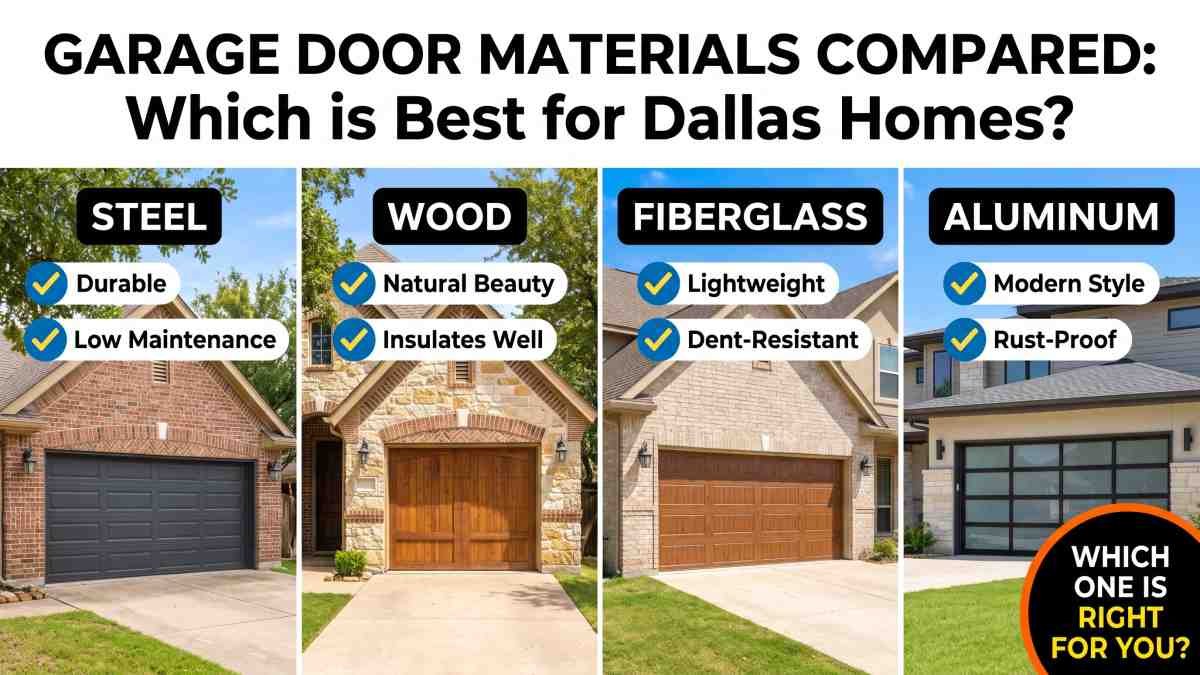
In short: No garage door material wins everywhere. Choose by hail and dents, upkeep, weight, look and budget. Clopay reports steel as generally the most affordable, wood needs the most upkeep, and weight affects springs, which only professionals touch. Here are garage door materials compared on those points for a Dallas home.
Start With the Problem You’re Solving, Not the Material Name
How to choose a garage door material comes down to five factors: hail and dents, upkeep, weight, look and budget. Each material is strong on some and weak on others, so none wins on all five. Rank the factors for your own house first, then match a material to them.
A ranked list of “best materials” hides that trade-off. Clopay says steel needs only occasional soap-and-water cleaning, but steel can dent. Wood offers a look nothing else matches, and it asks for the most care.
If you’re still deciding whether to replace the door at all, start with our guide on how to repair or replace a garage door. Come back here once you know a new door is the plan.
The Six Materials, One at a Time
The types of garage door materials you’ll see most are steel, wood, aluminum with glass, fiberglass, vinyl and composite overlay. This garage door material comparison uses manufacturer and magazine sources, and every entry names its source and ends with the catch.
Steel
Clopay calls steel generally the most affordable option and says it won’t crack, warp or rot. Overhead Door says steel can dent on heavy impact, and Clopay adds that thinner-gauge steel dents more easily than thicker insulated steel. Clopay says most steel doors are coated to resist rust.
The catch: do steel garage doors rust? Not by default, but a scratch can expose the metal to moisture, so Clopay advises repainting a damaged spot promptly.
Wood
This Old House says wood offers the widest selection of styles and can be painted or stained to match your home. Clopay says natural wood needs the most maintenance, with sanding, staining or repainting on a schedule that depends on climate and sun exposure.
The catch: Overhead Door says wood needs re-sealing every 2 to 5 years and suits mild or dry environments, and Clopay says unsealed or poorly maintained wood can warp, swell or rot. Do wood garage doors require more maintenance than the rest? Every source we read says yes.
Aluminum and glass
Clopay says aluminum is not susceptible to rust or corrosion, and that glass sections let light into the garage. Clopay also describes aluminum doors as lightweight.
The catch: Bob Vila says aluminum panels are easier to dent, and Clopay says aluminum is sensitive to extreme heat. Do aluminum garage doors dent easily? That’s the only dent claim we found, so ask the company how a specific panel holds up.
Fiberglass
Overhead Door calls fiberglass dent-resistant and rust-proof, and Bob Vila says it is less subject to denting or cracking. This Old House says fiberglass can mimic painted or stained wood without the weight or upkeep.
The catch: Bob Vila says fiberglass can break upon impact, and This Old House says it may crack in extremely cold weather. So do fiberglass garage doors crack? Reportedly yes, under a hard hit or in extreme cold, though we found no figures.
Vinyl
Bob Vila calls vinyl very durable and difficult to dent or break, and says it needs little upkeep beyond an occasional hosing. This Old House says vinyl has a stiff foam core.
The catch: Bob Vila says vinyl comes in fewer colors than fiberglass, and This Old House says it may crack in extremely cold weather. Are vinyl garage doors durable? The sources say yes, but none gives a lifespan.
Composite overlay
Clopay builds composite doors as an insulated steel base topped with a moisture-resistant overlay molded from natural wood boards. Clopay says the overlay won’t warp, shrink or rot from moisture, and that soap-and-water cleaning is enough.
The catch: Clopay says composite overlays are not easily repaired, so a deep scratch or large dent may mean replacement. Do composite garage doors look like real wood? They imitate it, but they aren’t wood, as Clopay itself notes.
Side by Side: Dents, Upkeep, Weight and Heat
Steel vs wood garage doors is mostly a trade of dents for upkeep: steel can dent, while wood asks for the most care. Steel vs fiberglass is a trade of dents for cracks, since fiberglass resists dents but can break on impact. The table puts garage door materials compared on the points the sources report most, and heat gets its own section next.
For R-value and U-factor, which this table leaves out, see our guide to garage door insulation and R-value for Texas heat.
| Material | Dents | Rust or rot | Upkeep | Weight |
|---|---|---|---|---|
| Steel | Can dent; thicker insulated steel resists better (Overhead Door, Clopay) | Coated; scratches can let rust start (Clopay) | Soap and water (Clopay) | Not stated |
| Wood | Not stated | Can warp, swell or rot if unsealed (Clopay) | Most upkeep; re-seal every 2 to 5 years (Overhead Door) | Considerably heavier than steel or aluminum (Clopay) |
| Aluminum and glass | Easier to dent (Bob Vila) | Not susceptible to rust (Clopay) | Not stated | Lightweight (Clopay) |
| Fiberglass | Dent-resistant but can break on impact (Overhead Door, Bob Vila) | Rust-proof (Overhead Door) | Low; occasional clear coat (Overhead Door) | Lighter than wood (This Old House) |
| Vinyl | Difficult to dent or break (Bob Vila) | Not stated | Occasional hosing (Bob Vila) | Not stated |
| Composite overlay | Not stated; badly dented overlay may need replacing (Clopay) | Moisture-resistant overlay won’t warp or rot (Clopay) | Soap and water (Clopay) | Not stated |
Note: Each cell is reported by the source named, and “Not stated” means the sources we read gave nothing. Figures vary by door, so the quote and the warranty for the door you buy come first.
How Hail and Summer Sun Treat Each Material
Hail dents or cracks garage door panels, and summer sun wears finishes, but the material decides which problem you get. Steel and aluminum tend to dent, fiberglass resists dents but can break, and wood needs more care in sun. No neutral source ranks the materials for Dallas.
North Texas has a documented worst case: the National Weather Service in Fort Worth reports that on April 11, 2016, an intense supercell crossed North Texas and produced a 5.25-inch hailstone, a record for its forecast area. In Wylie, the page says 80% of homes were affected and over $300 million in damage occurred. Its page on the April 11, 2016 North Texas hailstorm has the full details.
That storm is the extreme case, but it shows why dents, cracks and rust are three different problems. So which garage door material is most resistant to dents? Overhead Door says steel can dent on heavy impact and Bob Vila says aluminum is easier to dent, while Bob Vila says fiberglass resists denting but can break on impact.
Rust is the slow problem. Clopay says most steel doors are coated against it and advises repainting scratches promptly, while aluminum and fiberglass are described as rust-proof.
Summer adds a different test. National Weather Service records for DFW show 71 days at 100 degrees or above in 2011, a run of 42 in a row from June 23 to August 3, 1980, and an average first 100-degree day of July 1. That leaves the best garage door material for hot climates unsettled: Clopay says wood best suits mild climates and aluminum is sensitive to extreme heat.
We found no neutral source that ranks materials for Dallas hail or heat, so treat these as reported traits, not a verdict. If hail is your main worry, ask the company about steel thickness and what the panel warranty covers.
Why Every Page Gives a Different Lifespan
Garage door lifespan figures differ from page to page, and we found no neutral number. Clopay says a quality steel door can last 15 to 20 years or more on one page and up to 30 years on another. Treat any single figure as the seller’s estimate, not a promise.
How long do garage doors last? Clopay’s own wording shows the spread: steel up to 30 years, well-maintained aluminum up to 30 years, and natural wood “decades” when properly cared for.
So which garage door material lasts the longest? No source we read answers that with evidence.
Use two tie-breakers instead of a lifespan claim: the written warranty and the upkeep you’ll actually do. Ask what the warranty covers on the finish and on the panels, and for how long, and get the answer in writing.
Weight Changes the Springs: Why a Heavier Door Needs a Technician
Material changes a door’s weight, and the springs have to match that weight. Clopay says natural wood is considerably heavier than steel or aluminum, and American Door Supply lists door weight as one of four measurements used to size torsion springs. A technician should match the springs to the new door.
This Old House says fiberglass can mimic wood without the weight or maintenance requirements, and Clopay says wood’s weight can make manual operation harder, especially on larger doors. We found no neutral weight figure for any material, so this guide gives none.
That’s why a material swap isn’t a cosmetic change. If you move from a steel door to wood, or from wood to fiberglass, the torsion springs have to suit the new weight, and ask who will match them. Our page on spring repair explains what a technician checks.
DASMA, the Door & Access Systems Manufacturers Association, says spring systems are dangerous and should be repaired only by trained professionals, and it recommends that trained door systems technicians install garage doors. Its garage door safety tips page has the full guidance.
Do not touch: springs, lift cables and bottom brackets
These parts carry the door’s weight under high tension, and DASMA says only trained professionals should handle them. Never adjust or swap one to suit a heavier or lighter door, because a slip can cause serious injury.
Not sure what is wrong? Call, describe the problem, and ask for a written quote before work starts.
Dallas Garage Door Fix is a homeowner resource that connects you with a participating local garage door company. We don’t perform the repairs ourselves, and we may receive a referral fee from participating companies. Response times and prices are set by the company that takes your call.
What Each Material Asks of You Year After Year
Which is the best low-maintenance garage door material? Steel, composite overlay, fiberglass and vinyl all come out low in the sources we read, and wood comes out highest. The maintenance requirements below are what those sources describe.
- Steel: soap and water, per Clopay, plus prompt repainting of scratches. That stops rust from starting.
- Composite overlay: soap and water, per Clopay. The overlay can’t be repaired easily, so avoid scrapes.
- Wood: sanding, staining or re-sealing, every 2 to 5 years per Overhead Door. Skipped upkeep invites warping, swelling or rot.
- Fiberglass: an occasional clear coat, per Overhead Door.
- Vinyl: an occasional hosing, per Bob Vila.
- Aluminum: the sources we read give no routine, so ask the company.
Match the Material to Your Priority
Which garage door material is best for a tight budget? Clopay says steel is generally the most affordable option.
Which one adds the most curb appeal? Sources point to wood for its range of styles, and to composite overlay or fiberglass for a wood look with less upkeep.
| If your priority is | Materials reported to fit | The catch |
|---|---|---|
| A tight budget | Steel (Clopay: generally the most affordable) | Thinner steel dents more easily; thicker insulated steel resists dents better but costs more (Clopay) |
| Worry about hail | Thicker steel; fiberglass or vinyl (reported dent-resistant) | Fiberglass can break on impact, and no source ranks materials for hail |
| The least upkeep | Steel, composite overlay, fiberglass, vinyl | Steel scratches need prompt repainting; composite is hard to repair |
| A wood look without wood’s upkeep | Composite overlay on steel; fiberglass | Composite isn’t real wood; fiberglass may crack in extreme cold |
| Natural wood character | Wood | Most upkeep and weight; re-sealing every 2 to 5 years |
| A lighter door | Aluminum; fiberglass | Aluminum dents more easily |
Note: Matches come from the sources named in the sections above, not from a test. No prices are shown here, so ask for a written quote that lists parts and labor.
What to Ask the Company Before You Choose
Bring this list to any quote. It works as a garage door material selection guide you can mark up as you compare.
- What steel thickness and how many layers is this door? Clopay says thinner steel dents more easily, and Overhead Door says steel comes in single, double and insulated triple-layer builds.
- What does the written warranty cover on the finish and the panels, and for how long? Lifespan claims vary, so the warranty is the figure you can hold the company to.
- Will matching panels stay available for this style? A dented panel is easier to fix if the style is still made, and Clopay says composite overlays are not easily repaired.
- Who matches the springs to this door’s weight? The material changes the weight, and DASMA says springs are professional-only.
- Is everything on a written quote with parts and labor? An itemized quote lets you compare companies on the same terms.
Should you replace your garage door with a different material? Ask each company to quote the same size in two materials, so the difference shows line by line. Our guide on how to choose a garage door company in Dallas covers what that quote should include.
Door stuck right now? Call, describe the problem, and ask for a written quote before work starts.
Dallas Garage Door Fix is a homeowner resource that connects you with a participating local garage door company. We don’t perform the repairs ourselves, and we may receive a referral fee from participating companies. Response times and prices are set by the company that takes your call.
Frequently Asked Questions
The main garage door materials are steel, wood, aluminum with glass, fiberglass, vinyl and composite overlay. Clopay lists steel, composite overlay, natural wood and aluminum with glass, and Bob Vila and This Old House add fiberglass and vinyl. Each has a different catch, covered in the sections above.
No neutral source answers that. Clopay says a quality steel door can last 15 to 20 years or more on one page and up to 30 years on another, and says natural wood can last decades when properly cared for. Use the written warranty and your own upkeep as the tie-breakers.
No neutral source ranks materials for hail. Overhead Door says steel can dent on heavy impact and Bob Vila says aluminum is easier to dent, while Bob Vila says fiberglass resists denting but can break on impact. Clopay says thicker steel resists dents better, so ask about thickness and the panel warranty.
It depends on what you value. Clopay calls steel generally the most affordable and low in upkeep, while This Old House says wood offers the widest range of styles but needs the most maintenance. Choose steel to keep upkeep and cost down, and wood if the look matters more.
Not by default, since Clopay says most steel doors are coated to resist rust. A scratch can expose the metal to moisture, so Clopay advises repainting the spot promptly. Check the door after a hailstorm or a scrape from a car for chipped paint.
Steel, composite overlay, fiberglass and vinyl all rate low in the sources we read, and wood rates highest. Clopay says steel and composite need soap-and-water cleaning, and Bob Vila says vinyl needs an occasional hosing. Wood needs re-sealing every 2 to 5 years, per Overhead Door.
The sources cite moisture and sun, not Dallas specifically. Clopay says unsealed or poorly maintained wood can warp, swell or rot, and that wood best suits mild climates. National Weather Service records show long runs of 100-degree days at DFW, so ask the company about wood’s upkeep and keep the finish sealed.
Reportedly they can. Bob Vila says fiberglass can break upon impact, and This Old House says it may crack in extremely cold weather. We found no figures on how often, so ask the company what the panel warranty covers.
It affects the springs through weight. Clopay says natural wood is considerably heavier than steel or aluminum, and American Door Supply lists door weight as one of four measurements used to size torsion springs. We found no source tying material to opener choice, so ask the company who matches the springs to the new door and whether your opener suits it.
You can, but plan for the weight change. A different material can change the door’s weight, which means the springs have to match, and that’s a technician’s job. Ask the company to quote the same size in two materials so you can compare them line by line.
That covers garage door materials compared, from steel to composite overlay, for a Dallas home. For plain-language help with specific problems, start at the Dallas Garage Door Fix homepage.
Ready to talk to someone? Call, describe the problem, and ask for a written quote before work starts.
Dallas Garage Door Fix is a homeowner resource that connects you with a participating local garage door company. We don’t perform the repairs ourselves, and we may receive a referral fee from participating companies. Response times and prices are set by the company that takes your call.