
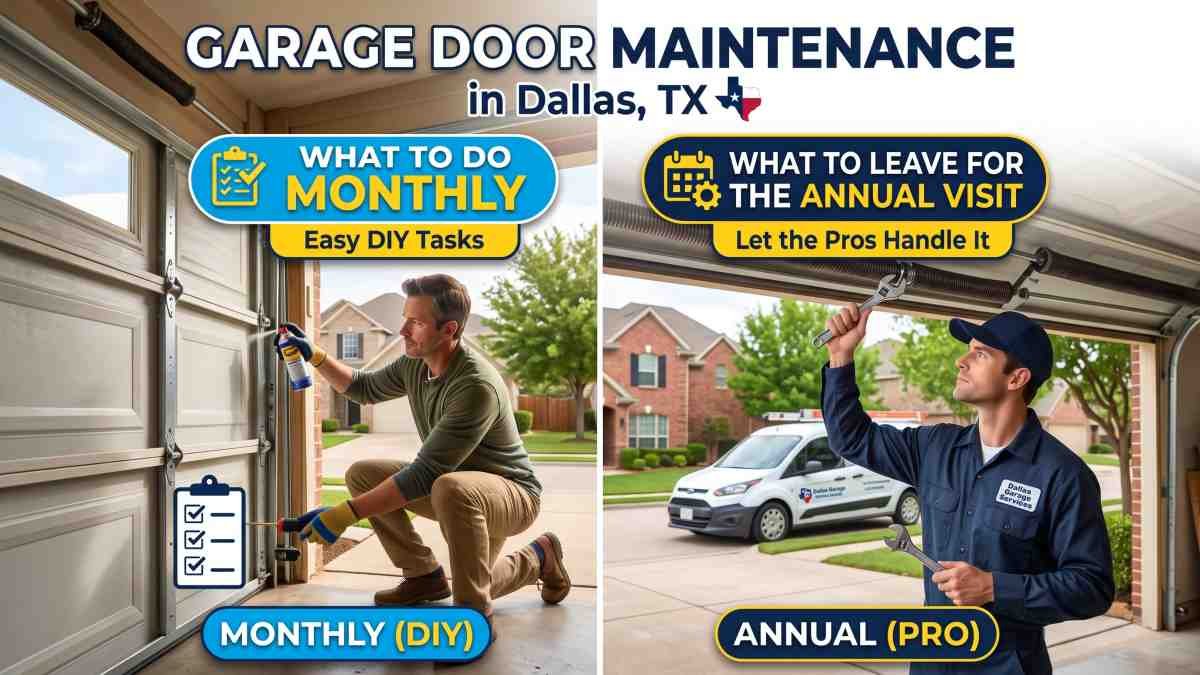
DASMA says your garage door needs monthly safety checks from you and an annual visit from a trained technician. Most of your part is looking, listening and testing. Lubrication is the only hands-on job, and it has rules. This guide to garage door maintenance Dallas homeowners can follow shows what to do and what to leave alone.
Why order matters more than oil: how a tune-up is really done
A tune-up works in a fixed order: check the balance and hardware, clean, lubricate, then test the safety systems. Skipping ahead to the spray can is the most common mistake. Lubricating a loose, unbalanced or dirty door just hides the problem.
Clopay, a garage door manufacturer, puts its pre-lubrication checklist first: inspect the door’s balance, tighten loose hardware, clean the components, look for wear and check the seals. Only then does it say to lubricate. That is the same sequence a good technician follows.
DASMA, the Door & Access Systems Manufacturers Association, splits the job in two. You handle monthly checks. A trained door systems technician handles the yearly visit and anything involving spring tension. This page covers residential sectional doors. Commercial and roll-up doors follow different maintenance rules.
How often: a monthly, six-month and yearly schedule
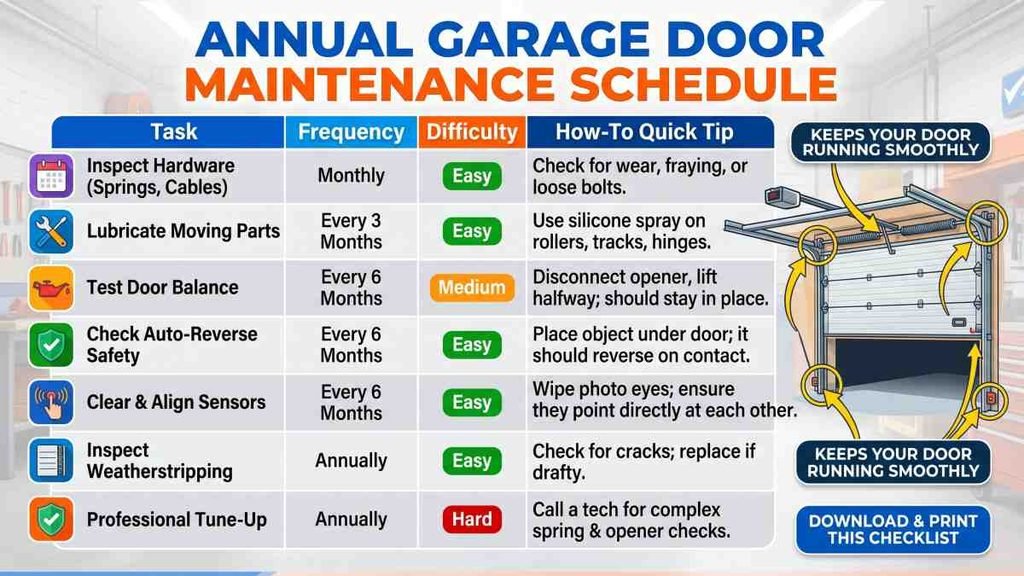
How often should a garage door be serviced? Check it monthly, lubricate it every 3 to 6 months, and book a trained technician once a year. That is the schedule DASMA, the U.S. Consumer Product Safety Commission (CPSC) and Clopay each point to for their part of the job.
| When | Who | What |
|---|---|---|
| Every month | You | Look, listen, test the reverse function and photo-eyes, check the balance |
| Every 3 to 6 months | You | Lubricate hinges, rollers, springs and bearing plates; wipe the tracks clean |
| Once a year | Trained technician | Full tune-up, spring and cable inspection, safety tests |
| After a storm or an impact | You, then a technician | Look for changes, and call if the door sits, sounds or moves differently |
Note: Clopay says to re-lubricate about every 3 months for heavy daily use and about every 6 months for average use, and more often in dusty or humid climates. CPSC recommends inspecting the door and opener every 30 days.
Springs wear out by cycles, not calendar years. One cycle is one full open and close. A1 Garage Door Service reports that a standard spring is rated for about 10,000 cycles, and that high-cycle springs are rated higher.
You can work out your own pace. Count how many times the door opens and closes on a normal day, multiply by 365, and divide your spring’s rating by that number. A busy household reaches the rating sooner than a one-driver home.
The ten-minute monthly check you can do from the floor
Most of the monthly check takes ten minutes and needs no tools. Stay on the floor, keep your hands out of the door’s joints, and stop at the first sign of trouble.
Look
Check the cables that run from the spring system to the bottom brackets on both sides. DASMA says frayed or worn cables can break and cause injury. Look at the springs, hinges, rollers and bracket bolts, too, but only look.
Listen
Run the door and listen. DASMA says springs can squeak from normal use. It suggests a spray-on lubricant made for garage doors before you call anyone. A grinding, popping or scraping sound is different, and it points to worn rollers or a binding door.
Balance
A balanced door stays put when stopped partway. CPSC says to close the door first, pull the red release to detach it from the opener, then move the door by hand. Federal opener instructions say to use the release with the door closed whenever possible.
Lift the door partway by its handle and let go. If it stays, that is a good sign. If it drifts, drops or feels very heavy, stop. CPSC says a severely unbalanced door can crash to the floor and should be serviced by a professional.
Reverse and photo-eye tests
Federal opener instructions under 16 CFR §1211.16 tell owners to test the opener monthly. The door must reverse when it meets a 1½-inch object or a 2×4 laid flat on the floor. DASMA adds a photo-eye check: the sensors should sit no higher than 6 inches off the floor, and blocking one with an object over 6 inches tall should stop the door closing.
Run both tests. If either fails, our page on garage door sensor repair in Dallas explains what to do next.
Lubrication done right: what to oil, what to skip
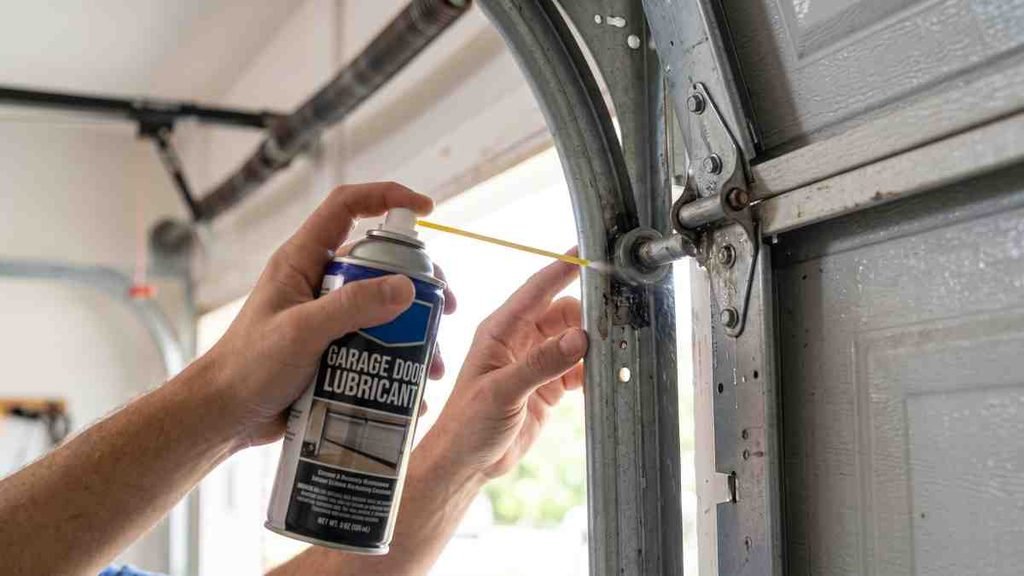
What should you lubricate on a garage door? The hinge pins, the rollers, the springs and the bearing plates, using the right product and a light hand. The tracks and nylon rollers stay dry. Getting that last part wrong is the most common lubrication error.
Which parts
Clopay says to lubricate the hinge pins and the rollers, but not nylon rollers. It also says to lubricate the springs and bearing plates at the top of the door. On a torsion-spring door, spray the full length of the spring. On an extension-spring door, lubricate the pulleys.
Which product
Clopay recommends a silicone-based lubricant, which it says doesn’t attract dirt. White lithium grease is the other good option, but it can attract dirt, so use it sparingly. Wipe off any excess so nothing drips.
What stays dry
Wipe the tracks clean with a damp cloth, and don’t lubricate them. Clopay says lubricant on the tracks makes it harder for the rollers to move and forces the opener to work harder. It also says to avoid WD-40 and oil-based products because they attract dirt and dust.
Garage door manufacturer Clopay recommends silicone-based lubricant or white lithium grease on hinge pins, rollers, springs and bearing plates, and it says to avoid WD-40 and oil-based products because they attract dirt. Its guide to lubricating garage door components also says to wipe the tracks clean rather than lubricate them, to skip lubricant on nylon rollers, and to re-lubricate every 3 to 6 months depending on use and climate.
What stays with a technician: springs, cables, bottom brackets and balance adjustment
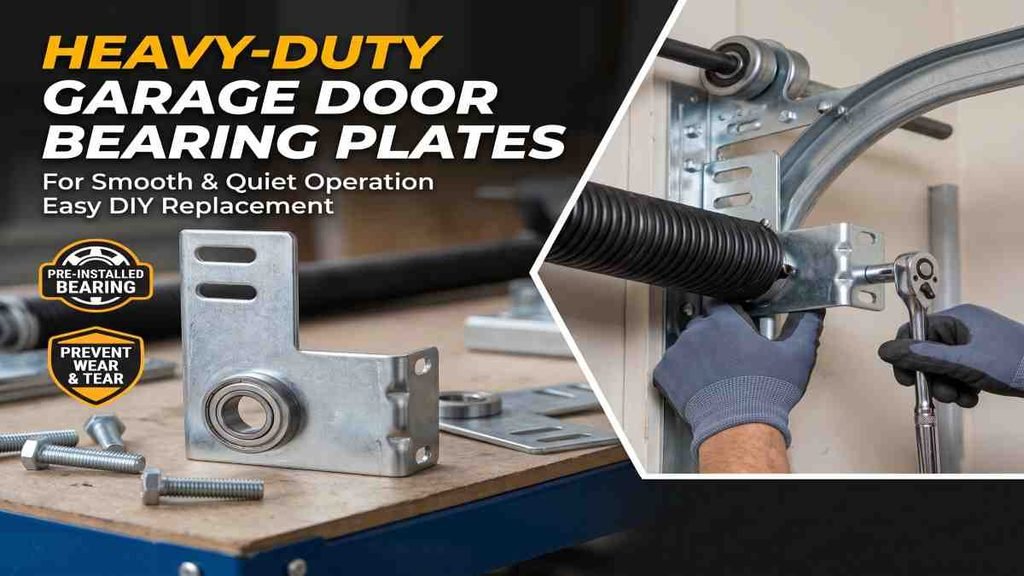
Can you adjust the springs yourself? No. DASMA calls springs arguably the most important and most dangerous part of a door. It says spring systems should be repaired only by trained professionals.
Three jobs stay with a technician:
- Springs. DASMA says an older door’s springs should be inspected by a professional and replaced if needed. If your door has two springs, both should be replaced even if only one has broken.
- Cables. You can look at them. Replacing frayed or worn cables belongs to a trained technician because of the spring tension involved.
- Bottom brackets. They connect to the springs and sit under extreme tension. Only a trained technician should adjust or loosen them.
If your door has extension springs, DASMA says it needs a safety cable through each spring. That cable keeps a broken spring contained. If you have extension springs and no safety cable, ask for a safety inspection.
When a spring does fail, our page on garage door spring repair in Dallas explains the repair.
DASMA, the Door & Access Systems Manufacturers Association, says homeowners should do monthly safety checks and maintenance, and that an annual visit from a trained door systems technician helps keep a door operating safely and smoothly. Its garage door safety tips also say spring systems should be repaired only by trained professionals, that the bottom brackets tied to the springs should be adjusted or loosened only by a trained technician, and that if your door has two springs, both should be replaced even if only one has broken.
What a professional tune-up covers, step by step
Here is what a careful garage door maintenance Dallas visit should include, in order. You won’t do these steps yourself. This is what to expect and what to ask about.
- Test the balance first. The technician checks whether the door stays put partway before touching anything else.
- Inspect the springs, cables, rollers, hinges and brackets. This is a hands-on check of the parts you can only see from the floor.
- Tighten the hardware. Daily use loosens bolts, hinges and brackets.
- Clean and check the tracks. The tracks get wiped, and alignment gets checked.
- Lubricate the right parts. That means hinges, rollers, springs and bearing plates, and not the tracks.
- Check the opener. Force and travel limits get checked, and federal instructions say to retest after any adjustment.
- Align the photo-eyes and run the reverse tests. The beam test and the 2×4 test both get run.
- Check the weather seals. The bottom seal and the side stripping get a look for gaps and wear.
Point counts vary from company to company, so ask for the itemized list of what gets checked. A written list tells you more than a number. For belt-drive, chain-drive or screw-drive openers, follow your opener’s manual for the drive itself.
What changes the price of a maintenance visit
What affects the cost of garage door maintenance in Dallas? The door’s age and condition, the parts found worn, the opener type, and whether you buy a plan or a one-time visit. We don’t publish prices we can’t source, so ask for a written quote that lists parts and labor.
| Factor | What pushes the quote up | What to ask |
|---|---|---|
| Age and condition | A door with years of skipped care takes more time | When was it last serviced, and what did you find? |
| Door type and size | Two-car, insulated, wood or glass doors are heavier or more complex than a one-car steel door | Does the quote change for my door? |
| Worn parts found | Rollers, seals or hardware that need replacing | Is the part price separate from the visit? |
| Opener type | Smart or older openers may need extra testing | What do you test on the opener? |
| Tune-up only vs repairs | A repair found during the visit adds to the total | Will you quote repairs before doing them? |
| Plan vs one-time visit | A plan spreads cost over several visits | What does the plan include, in writing? |
| Timing | Urgent or after-hours calls | Does the price change by time of day? |
Note: This table lists cost factors, not prices. Ask for a written quote that lists parts and labor before work starts.
Tune-up, safety inspection or repair: which one are you buying?
A tune-up keeps a working door in shape, a safety inspection checks the safety systems, and a repair fixes something broken. Companies use these words loosely, so ask what the visit covers before you book.
| Option | Purpose | When it fits | What to ask |
|---|---|---|---|
| Tune-up | Adjust, tighten, lubricate and test a working door | Once a year, or when the door gets noisier or slower | What’s on the list? |
| Safety inspection | Check balance, reversal, sensors and fittings | After an impact, or when buying a home | Will I get the results in writing? |
| Repair | Replace or fix a failed part | When something breaks or binds | What failed, and why? |
| Plan | Scheduled visits, sometimes with discounts | If you want a yearly reminder | Do repairs come with it? |
Note: Names and contents vary by company. A written list of what each visit includes is the only reliable comparison.
A one-time tune-up and a plan can include the same work. The difference is whether the company schedules the next visit for you, and whether repairs are discounted or included. Ask for that in writing, and don’t assume it.
Noise, shaking, a heavy door or a reversing door: when it stops being maintenance
Some problems aren’t maintenance jobs. If lubrication and tightening don’t fix them, they point to a worn or failing part. Stop using the opener and call.
- A loud, grinding or popping door. Worn rollers or a binding door are likely. DASMA says a door that doesn’t go up and down smoothly may be unsafe.
- A door that shakes or moves unevenly. Check the cables by eye, then call. An uneven door can mean a cable or spring problem.
- A door that feels heavy or drifts. CPSC says doors that aren’t balanced, or that bind or stick, should be serviced by a professional.
- A door that reverses before it closes. That points to the sensors or the force settings, which the photo-eye and reverse tests above help you narrow down.
If a car is trapped or the door is stuck open with your home exposed, our page on emergency garage door repair in Dallas covers urgent situations. We can’t promise arrival times. Response times and prices are set by the company that takes your call.
Need a diagnosis? Call, describe the problem, and ask for a written quote before work starts.
Dallas Garage Door Fix is a homeowner resource that connects you with a participating local garage door company. We don’t perform the repairs ourselves, and we may receive a referral fee from participating companies. Response times and prices are set by the company that takes your call.
Dallas timing: before the March–June storm season, and in older homes
When should you schedule garage door maintenance in Dallas? Before severe-weather season starts. North Texas severe-weather season runs from mid-March through June, according to Harold Brooks of NOAA’s National Severe Storms Laboratory, quoted by the Fort Worth Star-Telegram. Booking the yearly visit ahead of it is our suggestion, not a rule.
After any storm or impact, run through the monthly check. Look at the cables and brackets, then run the door and listen for changes. Clopay says dusty or humid climates may need lubrication more often than average.
Dallas’s median home was built in 1981, reported by Point2Homes using Census data. In older neighborhoods such as Lakewood, ask whether the springs or the opener were ever replaced. The CPSC says the requirement for an external entrapment system, such as a photo-eye, came in 1993. An opener from before then may have none.
Seven things to ask before booking a tune-up or signing a plan
Before you agree to any garage door maintenance Dallas companies offer, ask these seven questions.
- Can I see the itemized checklist? Why it matters: it lets you compare visits, since point counts vary.
- Will I get a written quote with parts and labor before work starts? Why it matters: it stops the price changing mid-visit.
- What does the plan include, and do repairs come with it? Why it matters: a plan that covers only inspections is a different product from one that includes repairs.
- Can you show proof of insurance? Why it matters: it tells you who pays if something goes wrong.
- Who is actually coming to my house? Why it matters: you should know whether it’s the company’s own technician or a dispatched one.
- Will you give me the safety test results? Why it matters: it shows the balance, reversal and photo-eye tests were run.
- Is the parts-and-labor warranty in writing? Why it matters: it shows what’s covered if a part fails again.
A note on licenses. Texas doesn’t issue a general state contractor license, according to Levelset’s Texas licensing guide. Texas DPS says opener installers need no DPS license unless the operator connects to an alarm or logs entry and exit. A license number on a van proves little, so ask for proof of insurance.
Highland Park and University Park are separate municipalities surrounded by Dallas, so confirm the service area when you call.
Frequently asked questions
How often should a garage door be serviced?
DASMA says to do monthly safety checks yourself and to book an annual visit from a trained door systems technician. Clopay says to re-lubricate every 3 to 6 months. CPSC recommends inspecting the door and opener every 30 days.
What does a garage door tune-up include?
A good tune-up covers the balance test, a check of the springs, cables, rollers, hinges and brackets, hardware tightening, track cleaning and alignment, lubrication, opener force and limit checks, the photo-eye and reverse tests, and the seals. Point counts vary by company, so ask for the itemized list. A written list tells you more than a number.
Can I maintain my garage door myself?
Partly. You can look, listen, run the reverse and photo-eye tests, check the balance carefully, wipe the tracks and lubricate the right parts. DASMA says springs, cables and bottom brackets belong to trained technicians. Stop at the first sign of trouble.
Should I lubricate the tracks?
No. Clopay says to wipe the tracks clean with a damp cloth and not lubricate them. Lubricant on the tracks makes it harder for the rollers to move and forces the opener to work harder. Some guides say otherwise, so follow the manufacturer.
What lubricant should I use, and what should I avoid?
Clopay recommends a silicone-based lubricant or white lithium grease. White lithium grease can attract dirt, so use it sparingly. Clopay says to avoid WD-40 and oil-based products because they attract dirt and dust, and to skip lubricant on nylon rollers.
How do I test whether my door is balanced?
CPSC says a balanced door stays in place when stopped partway. With the door closed, pull the red release, then lift the door partway by its handle and let go. If it drifts, drops or feels very heavy, stop and call a technician. Keep your fingers out of the joints, as DASMA warns.
How long does a tune-up take?
It depends on the door’s condition and what the technician finds. A door that has been skipped for years can take longer than one serviced every year. We can’t promise a time, so ask the company for a window.
What affects maintenance cost in Dallas?
The door’s age and condition, the door type and size, the parts found worn, the opener type, repairs found during the visit and whether you choose a plan. We don’t publish figures we can’t source. Ask for a written quote that lists parts and labor.
Is a maintenance plan worth it, and do plans include repairs?
It depends on what the plan includes, so ask for it in writing. DASMA recommends an annual visit from a trained technician. A plan is one way to schedule that visit, and some include discounts or repairs while others don’t.
Does maintenance prevent costly repairs or spring failure?
Maintenance helps, but it can’t stop a spring from wearing out. Clopay says lubrication reduces wear, and DASMA says regular service helps keep a door safe. Springs are rated in cycles, and A1 Garage Door Service reports about 10,000 for a standard spring. When a spring is replaced, DASMA says to replace both.
Can skipping maintenance void my door’s warranty?
We found no universal rule, because warranties differ by manufacturer and by door. Read the paperwork that came with your door and opener. Keep records of any service you have done, and ask the manufacturer or the company if the document is unclear.
Why is my garage door noisy or shaking?
Noise often comes from dry hinges or rollers, loose hardware or worn rollers. DASMA suggests a spray-on lubricant for squeaky springs. A door that shakes, grinds, binds or moves unevenly is a different matter. Stop using it and call a technician.
How do I choose a company, and does it need a Texas license?
Ask for an itemized checklist, a written quote with parts and labor, proof of insurance and a written warranty. Texas doesn’t issue a general state contractor license, and Texas DPS says opener installers need no DPS license unless the operator connects to an alarm or logs entry and exit. So a license number proves little. Ask what the company will test before it leaves.
If your door is due for a visit, run the monthly check first, then ask for a written quote. You can also browse other common door problems from the Dallas Garage Door Fix homepage.
Ready to talk to someone? Call, describe the problem, and ask for a written quote before work starts.
Dallas Garage Door Fix is a homeowner resource that connects you with a participating local garage door company. We don’t perform the repairs ourselves, and we may receive a referral fee from participating companies. Response times and prices are set by the company that takes your call.